LAX Micro Fest 2025 coincided with my throwing a party because I was leaving the country. Throwing a party is not only fun but also good for me. I feel generous, inclusive, curious. At a party, planned and unexpected encounters rub shoulders—the frottage pleasurable and mind-expanding at times, the friction of snags eliciting the inevitable “excuse mes” and hissy fits.
The Life of the Party
LAX Micro Fest 2025 at Pieter Performance Space
Review
Reviewing Micro Fest brings these party truths to mind. Not all parties or performance fests are a felicitous mix of personalities, but seeking that is the work of a good host and curator. Having seen the performance Aggregate by Linda Franke at Human Resources in Los Angeles the weekend before, I brought with me to Micro Fest questions about the role of the partygoer—the pressure that the audience’s presence exerts—that tethers its enjoyment to liveness itself.1During Aggregate, my gaze was held by four laboring bodies exchanging a fence, a tree stump, a well-like construct, and a rough boulder shape—but our bodies were distanced, wedged against a single wall. Our gaze as audience members was never met. Instead the performers turned to watch a far wall when it flickered with a video recording of someone scrolling through a crude, CAD-rendered 3D infrastructure-scape. I found myself wondering what audience the performance was imagined for, and how it was acknowledging or shaping us even while the work operated in a separate, insular world.
Curated by K. Bradford and produced by L.A. Performance Practice with Pieter Performance Space as the host venue, Micro Fest did not start with what we think of as genre-bending performance art. The opening made no claims about the body of the performer either, but was, in fact, the most traditional of all if we think in terms of human history: a grief ritual.
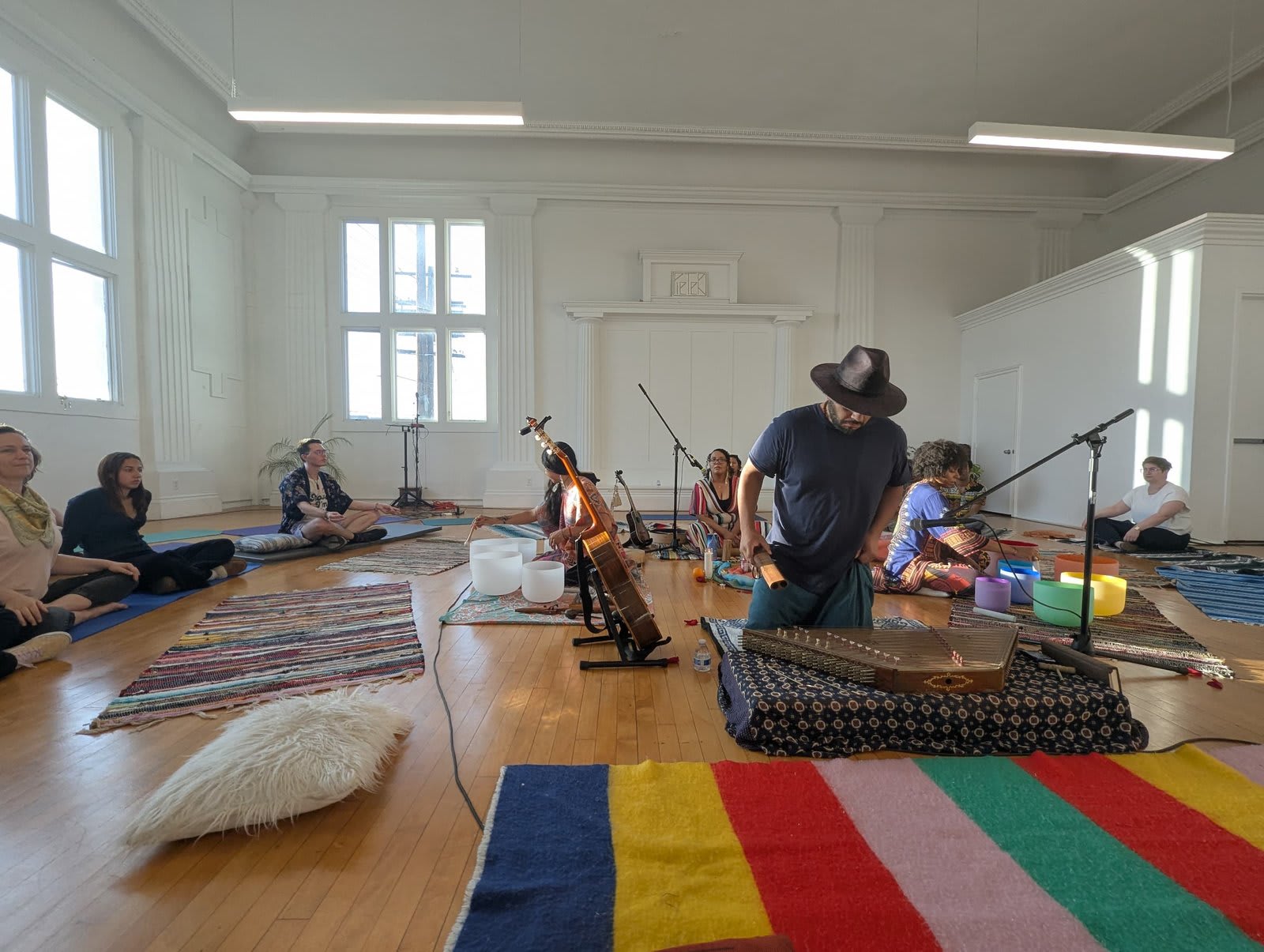
Pre-performance setup for Lindsey Red-tail with Eres Medicina, Opening Rainbow Grief Ritual, performed as part of LAX Micro Fest at Pieter Performance Space, Los Angeles, May 30, 2025. Photo: Neha Choksi
That opening ritual on Friday with Lindsey Red-tail and musicians Eres Medecina revealed a concern that remained throughout: Who is this party for? The earnest opening went beyond standard land acknowledgments in the wake of the recent Los Angeles fires. Land had been lost. Loss had to be welcomed. While I caught myself wondering how this ritual qualifies as a twenty-first-century performance—as if mere tradition and solidarity is not enough—this opening gambit deftly located our bodies as an audience. The ritual summoned us as Angelenas. Maurice Merleau-Ponty proposes that to have a body is to locate it, to engage in a spatial act. Instead of asking what can and cannot fit into a performance, or what is a live fest, maybe the task is to query the actions of a body, to ensure sensation’s primacy in embodying one’s ideas and politics. The call-and-response songs of Red-tail’s opening were sung together, providing a foundation for the audience to begin conjuring its relationship to the performers into a collective embodied being.
Over the three days of Micro Fest, the audience-cum-partygoers were bearing witness, examining where we are and who we are today. Many performers’ bodies were intersectionally and legibly Asian, Black, Indigenous, trans, white, cisgender, immigrant, privileged, laboring, but their identity position was not what really put them in conversation with us as the audience. The stated intention was “an act of radical futuring grounded in lineage and origins, [calling] in live performance as a luminous lifeline.”2“LAX Micro Fest 2025,” L.A. Performance Practice, accessed June 30, 2025, https://performancepractice.la/festival/lax-micro-fest-2025/. While sometimes the performances extended a helping hand that was easy to grab, at other times that hand remained unclasped. The identity of the body reverberates only if we are activated by the energy of the body. The performances, interactions, and even curated pairings that shone did so because they engaged not only the artist’s own body but also the body of the audience. There was space for the audience to think their own thoughts and experience their own bodies’ efforts to survive and thrive. These works were generous, inclusive, and curious.
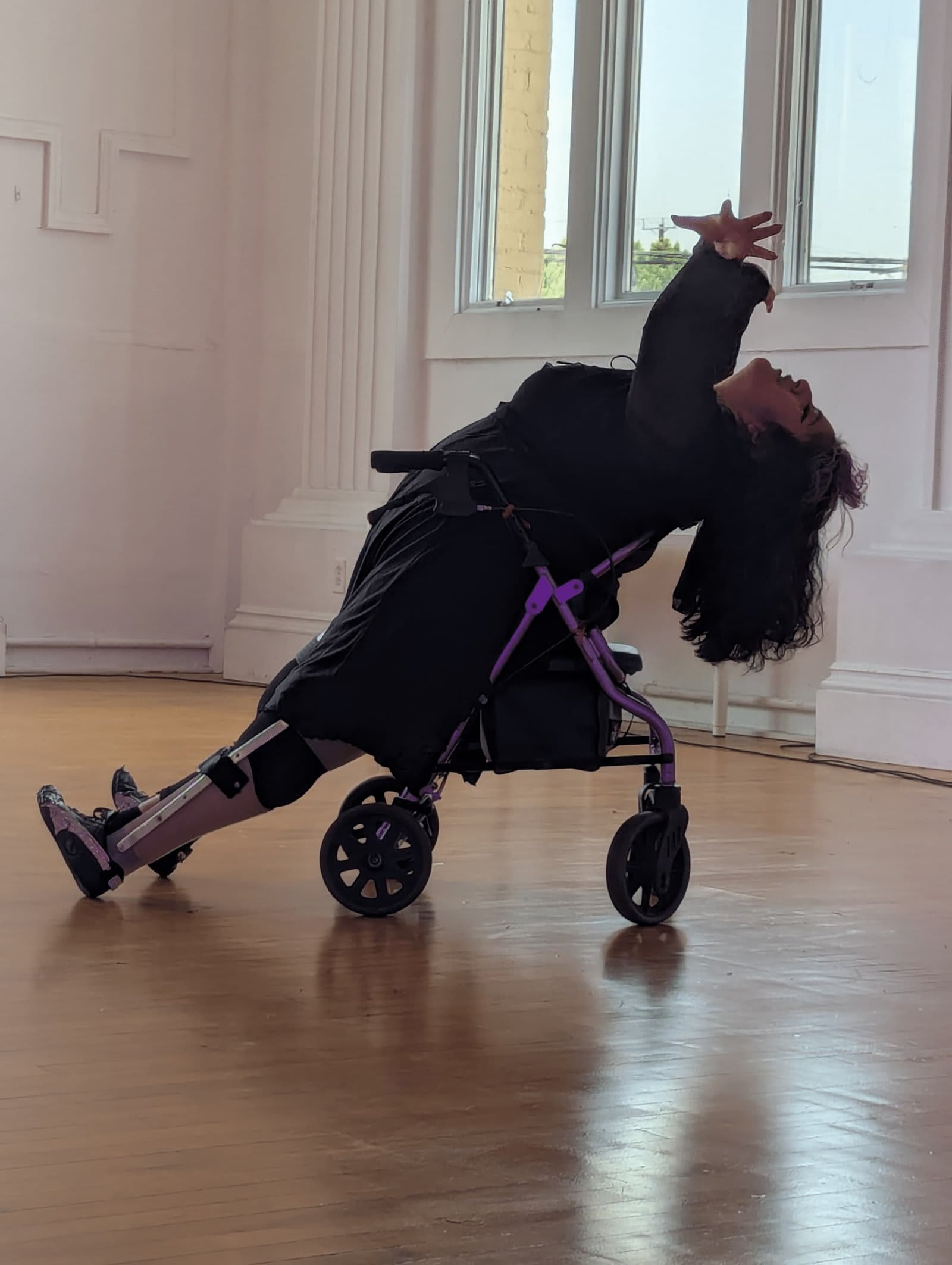
Vanessa Hernández Cruz, Patient Zero, performed as part of LAX Micro Fest at Pieter Performance Space, Los Angeles, May 31, 2025. Photo: Neha Choksi
So when is bearing witness enough? Vanessa Hernández Cruz’s Patient Zero on Saturday stretched the question. Any body can dance, even in stillness, à la John Cage’s intuition about silence. And any moving body part can be the locus, per Yvonne Rainer’s dancing fingers filmed to become Hand Movie (1966). The subject matter of Cruz’s dance was her marked body, as is common in many performances. Her straight legs extended from the seat of her body held up by a purple walker until she slipped off and around and under it. I understood the dance as a place for me to witness and for Cruz to show that she was taking care of herself.
Soothingly aware as it might have meant to be, the prerecorded soundtrack included earnest phrases like “Will of my ancestor” and “What if there is no past or future but we are spiraling?” and “Grief is a time capsule.” I found myself wishing for the dancer’s voice to address me directly, for it to resonate with her body and our bodies. I often had to bring myself back to the body in front of me. The voiceover took me away instead. I thought, how long can this (dance as) self-care go on? So the work then became about the experience of time afforded a body with a physical disability. Cruz’s arms and fingers moved in the manner of dancers who mimic modern Western dance gestures. There was something both inauthentic about these choreographic choices and simultaneously authentic about the desire to imitate that I perceived, which felt embarrassing to watch. And yet I wanted her to succeed. At what? I couldn’t quite pinpoint it, but I kept thinking of movements that are possible for her and probably difficult for me.3This remark comes from thinking about Michael Turinsky’s My body, your pleasure (2014), a choreographed dance that inserts itself into the critique of compulsory ableism in dance. The dance theorist Doran George complicates it here, “You want to be sexually objectified. . . . You’ve asserted the aesthetic value of your everyday kinetic patterns and broken with a prevailing assumption in contemporary dance that seamless able-bodied motion is a necessary foundation for choreography.” Is there a version of this dance that accepts her body as the natural body? In thinking about her stated concern about how the body can slow you down, and cross-cutting that with “Time is not real . . . I tell myself as everything slips away from me,” I realized what Cruz already knows—we need to think about not only ableist structures, but also ableist time.
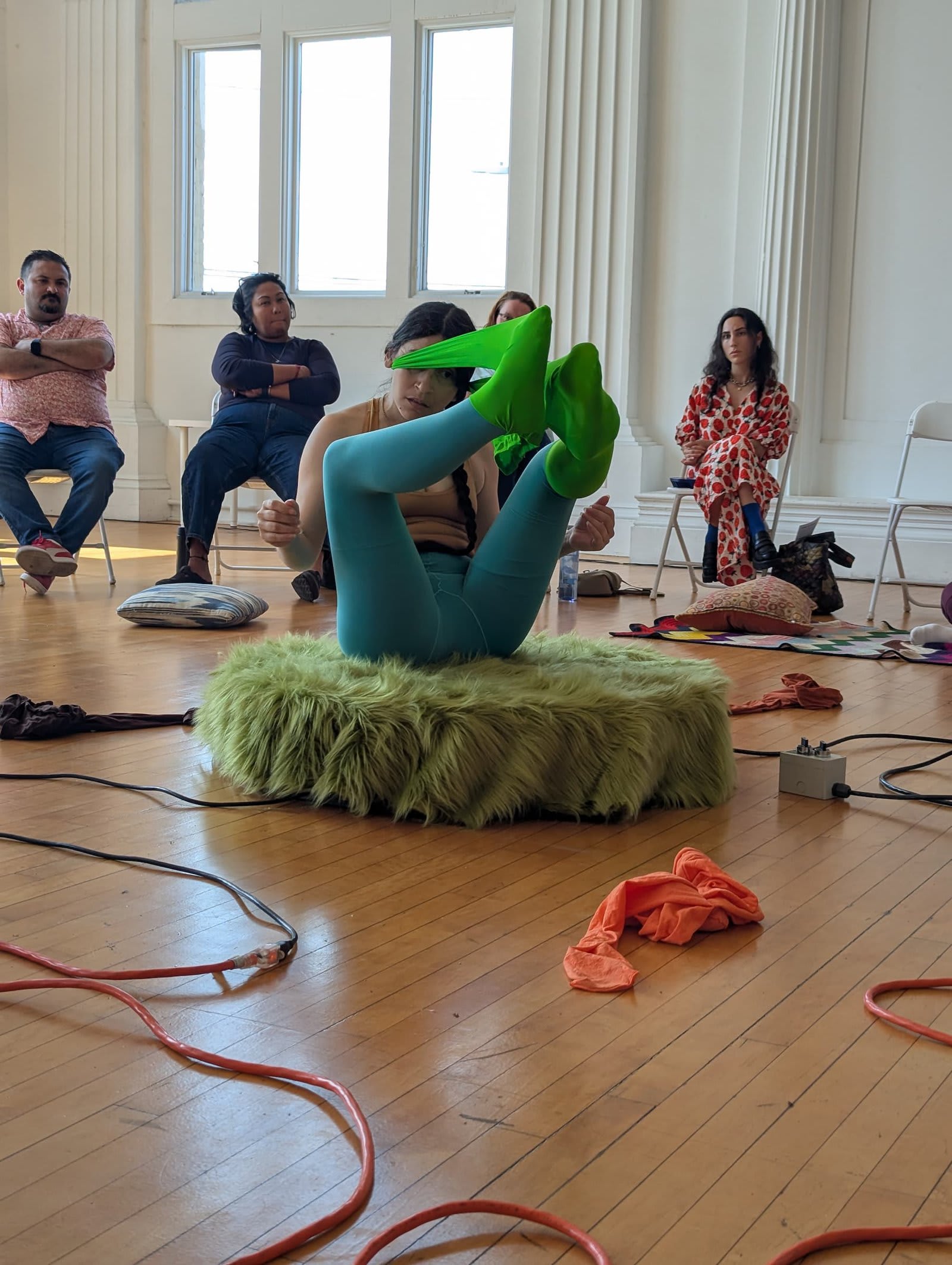
Toogie Barcelo and Joe Berry, Sound Body, performed as part of LAX Micro Fest at Pieter Performance Space, Los Angeles, May 31, 2025. Photo: Neha Choksi
One might think that performers inhabiting their bodies are the most successful at getting us to inhabit ours, but that did not turn out to be true. Something more was needed.
Toogie Barcelo and Joe Berry’s Sound Body choreographed a force field using formal structural elements. Barcelo’s body was isolated in the center, with Berry’s sound emanating from within the circle of viewers. Curled up in brown tights on a circular platform with green shag carpet, the vision was of artificiality and flesh. The body flipped a switch to start the platform rotating counterclockwise, surrounded by the audience. She started removing her brown tights and, surprisingly, there was another pair underneath. She shed tights in sequence without getting up. Genres and modes mingled in dissonance, my inability to align them ensuring the constant rearrangement—natural body, artificial colors, soothing sounds, dancer’s tights in excess, strip club in action, twisting on a go-go platform, rotating music box princess, ceremonial ritual offering, in a bedroom, on an island, in a figure drawing class. The emotional distortions were reflected in real time that was in turn distended. Then the dancer surprised us by breaking the insularity of the performance and looked at each of us for the length of time it took for the platform to rotate their gaze past us. There was removal and shedding, but there was also an inviting in. We experienced both vulnerability and power. The friction generated by the rotating, shedding body meeting and breaking our gaze was, as an audience member aptly described it, “emotionally rearranging.” The messy friction of a good party was achieved, even if questions remain.
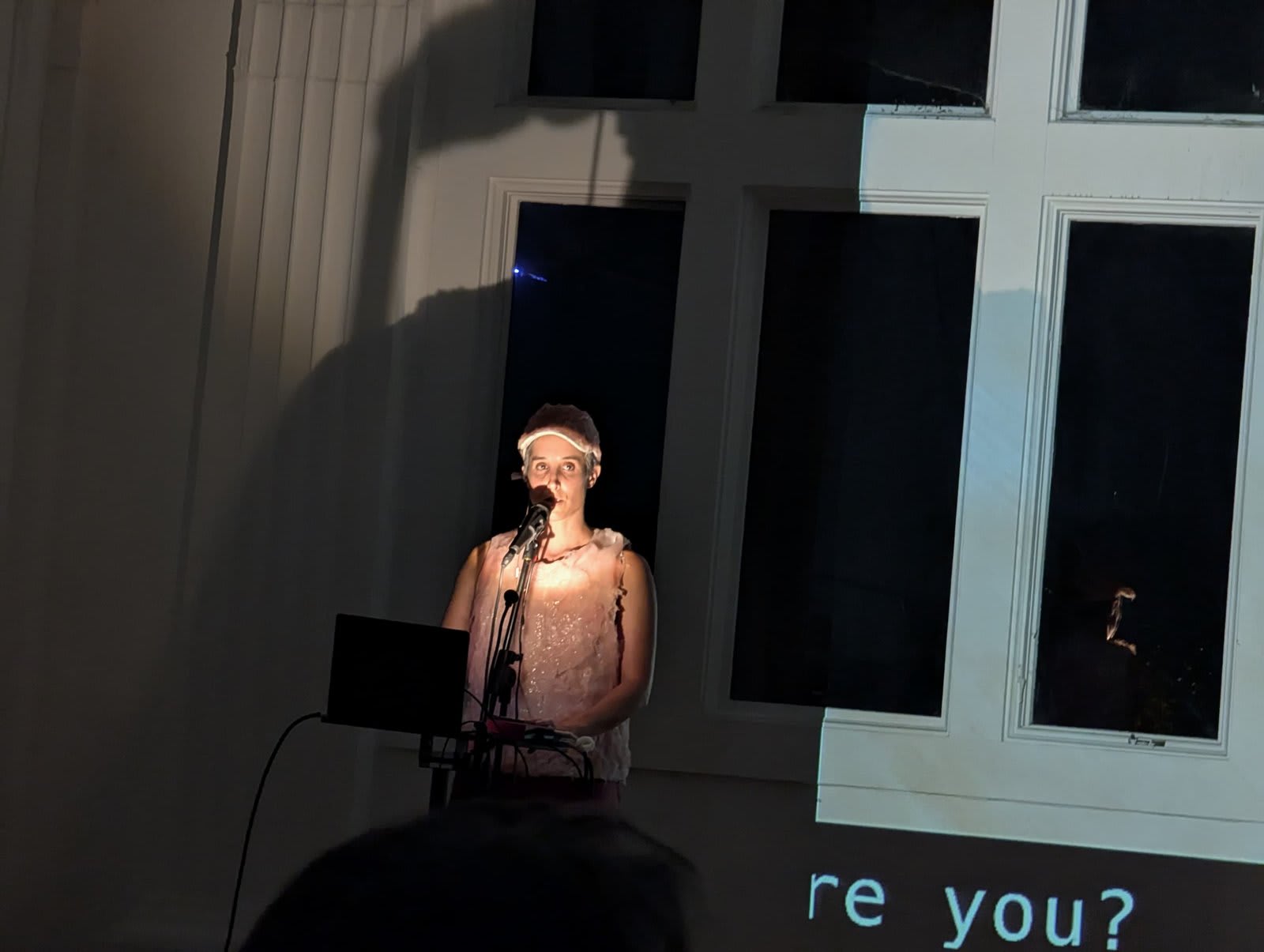
Nina Sarnelle, Mouth Noise, performed as part of LAX Micro Fest at Pieter Performance Space, Los Angeles, May 30, 2025. Photo: Neha Choksi
Friction came in many flavors. In Mouth Noise Nina Sarnelle presented original, sometimes trenchant songs about strains of postcapitalist ecological destruction. Unpredictably they spoke, wailed, and sang from behind a podium stage right, instead giving primacy to a large video projection. For one song, the video featured Sarnelle as a consumer or promoter in a blonde wig. In another instance, an animation featured organic bits and bodies blending and morphing impossibly with obviously technological means. While Sarnelle recited for us a list of recently extinct species, the recitation ticker-taped across the bottom like subtitles of value to no one except the mourner and the memorializer. A respected critic in the L.A. performance world walked out, irritated to have to see what they presumed was AI-generated video buttressing a song they could just as easily have experienced online. Yes, AI unthinkingly collaged extinct animal bodies and other fleshy items to create new forms; from Sarnelle’s critical and ironic bent I can see how they would appreciate the bitter truth that powering AI contributes to all kinds of extinction. Yet, what do AI- and CGI-decorated songs do in a live performance festival? It, too, remains a compelling question.
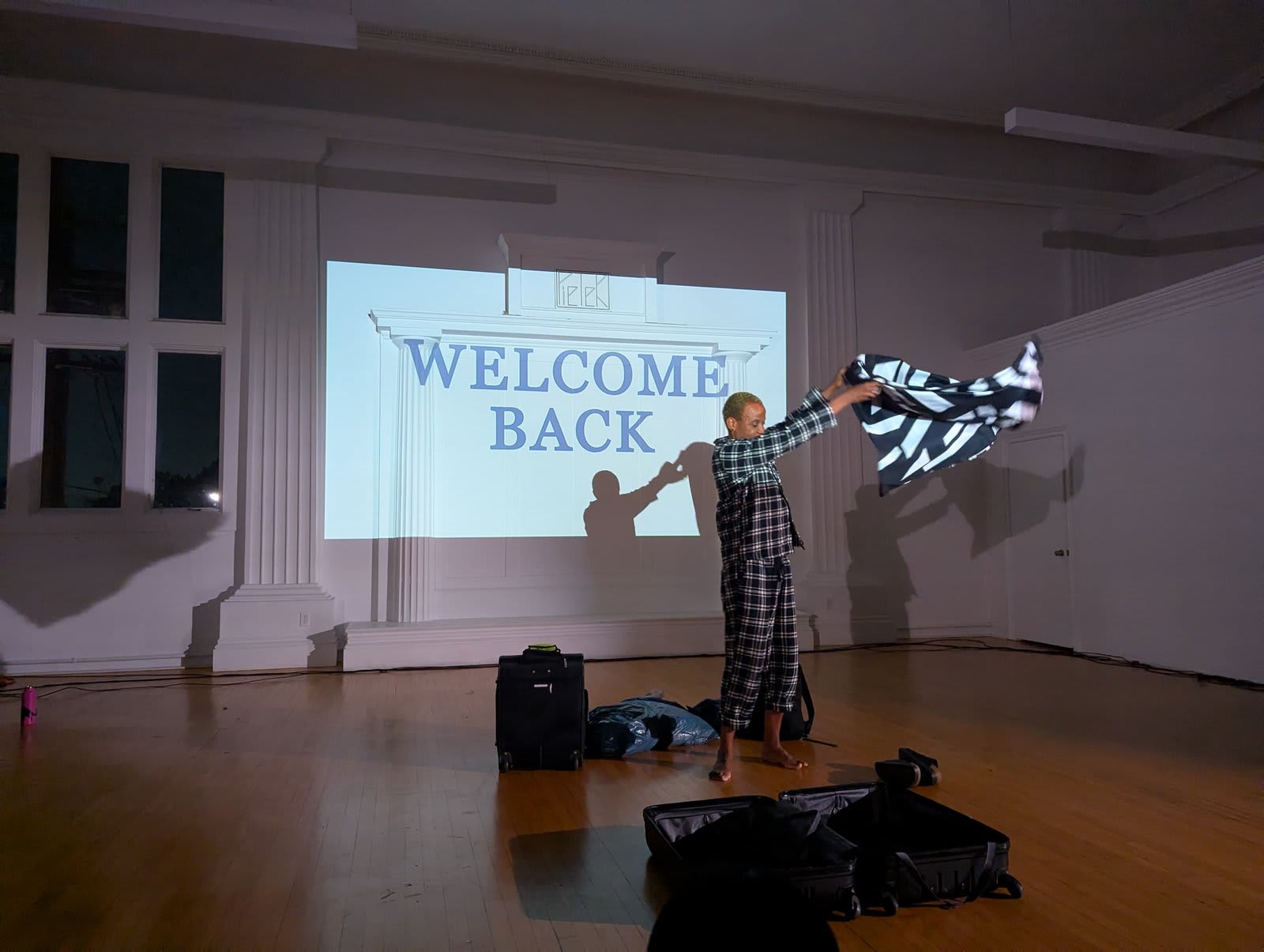
Paul Outlaw, Welcome Back, performed as part of LAX Micro Fest at Pieter Performance Space, Los Angeles, May 30, 2025. Photo: Neha Choksi
But the same respected critic returned to see Paul Outlaw in Welcome Back. Outlaw’s monologue understood that his real-life experience and the structure of the work could play off each other. The story goes that he was flying back from Berlin, landing at LAX at 6 p.m., and unsure that he would make it to this scheduled appearance. The curator told us Outlaw had contingencies in place for addressing the audience through video chat if detained, which emphasizes that he was always planning to address us directly. The stakes of the work in the Trump era were clear: He is Black, gay, and an actor. The veracity of his story was propped up by his suitcase and carry-on roller. He yo-yoed between his lived experiences of being a Black immigrant being stared at in Berlin, the gym etiquette of negotiating class and gender with cleaning ladies, and trying to pack himself back into his suitcase to the karaoke-style track of Dinah Washington’s 1949 song “Baby Get Lost.”
His stories resonated regardless of what embodied reality we inhabited. His patter, rehearsed as it may have been, was that of a performer who was sharing something that just happened on the way to the party, with “Can you believe it?” implied. At arrivals, the sole question posed to him by immigration was, “Are you traveling with someone?” Outlaw complained, “The officer did not say ‘Welcome back.’” The same rang true for me a month earlier, the same hole where words of welcome were expected, and I had complained to my wife that I missed the “Welcome back” that I had grown to expect from a lifetime of traveling back to LA from my other home abroad. I blamed it on the current administration, the same one that spawned Outlaw’s Welcome Back. While indeed this was scripted, it worked live as a performance because it was aware of all the relationships inside and outside the party that affect the bonhomie of collective presence.
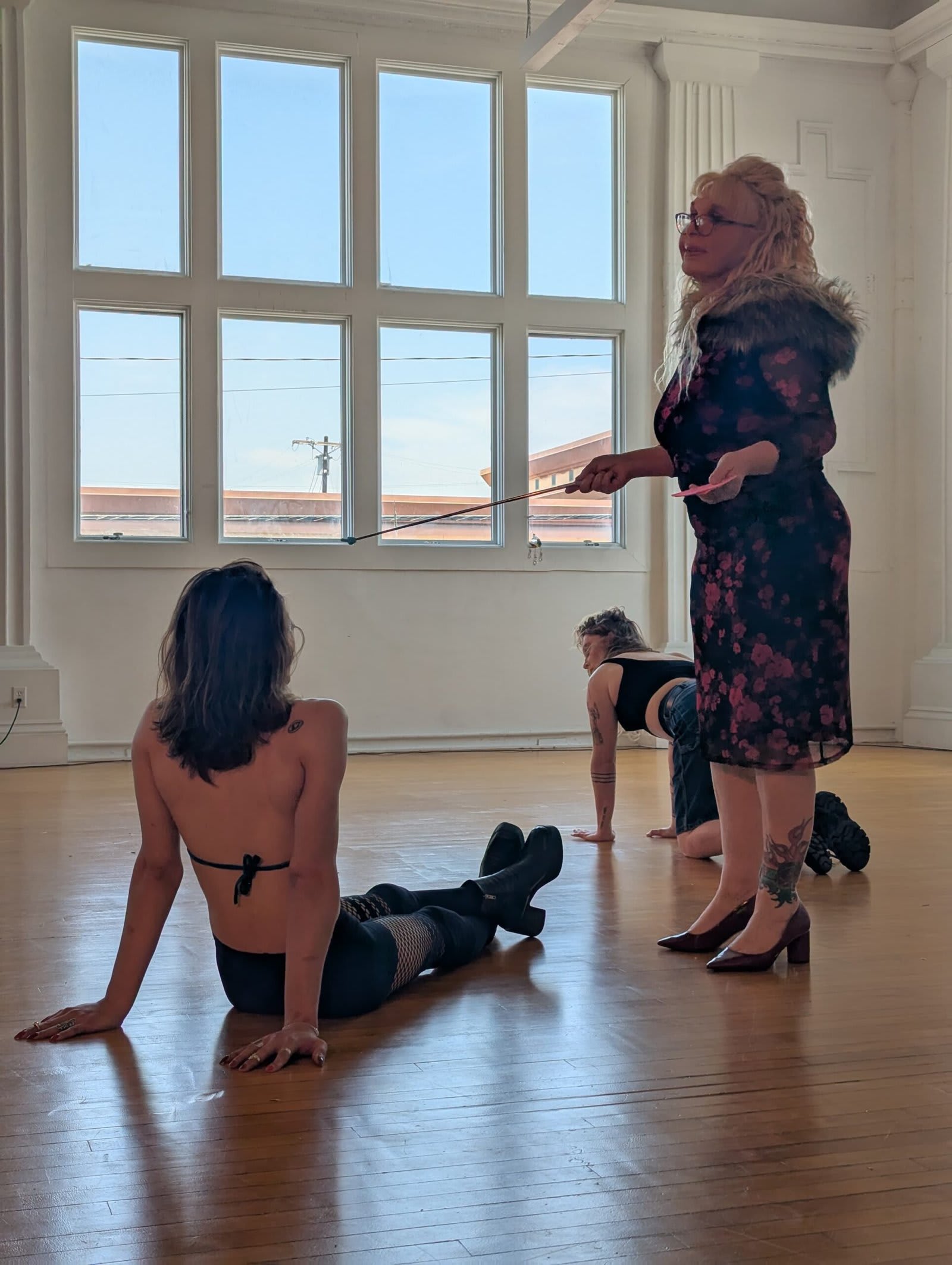
Wesleigh Gates with B Gosse, Farrah Hamzeh, and Tuesday Thomas, The Grafters, performed as part of LAX Micro Fest at Pieter Performance Space, Los Angeles, May 31, 2025. Photo: Neha Choksi
Another effective scripted work was The Grafters by Wesleigh Gates, who detourned any available body of knowledge to talk about transfeminine bodies. The main character, variously in skirts and a white lab coat, is mapped onto the person of Gates. She spoke directly to the audience, accompanied by three other transfeminine collaborators who were sometimes on all fours, looking at and being looked at within the stage world, and at times compositing themselves as a centipede or as line dancers. Collaging popular and intellectual concerns that cult and horror films and valorized theory books project onto transfeminine bodies, Gates illustrated her critique in an erudite voice that contrasted with Outlaw’s personal tone. Even so, Gates involved us continually by peppering us with questions and soliciting our opinions, and even asked three volunteers from the audience to graft into a single centipede. It was a messy, episodic work that ended in an emotional line dance. Despite their scripts, both of these works conveyed an aliveness that drew me in and pacified the disgruntled critic. They tapped into a liveness that made use of the audience. They needed our presence.
At one point during Micro Fest, a pairing of two writers, Noura Alhariri and Elizabeth Metzger, raised the question: How does the frame of performance translate to a traditional reading? Don’t words live in a mouth, and don’t mouths live in bodies? It was not until meital yaniv’s reading paired with rafa esparza’s performance that the role of the readings within the festival became clear. Kudos to the curator are due. yaniv’s reading changed the way esparza’s work lingered in my brain and body, amplifying the liveness of both.
Seated with a broken leg, yaniv softly worked their way through a chapter from their forthcoming book, Deathloving—an alchemy of letting go. Simultaneously tender, informative, and enraging, their words rendered already alert nerves afire as they negotiated the final breath of a dying empire as manifested in the current genocides in Gaza, Congo, Sudan, and Kashmir. yaniv said, “In order to see, navigate, and hold the pattern of empire I had to widen myself so that I don’t break.”
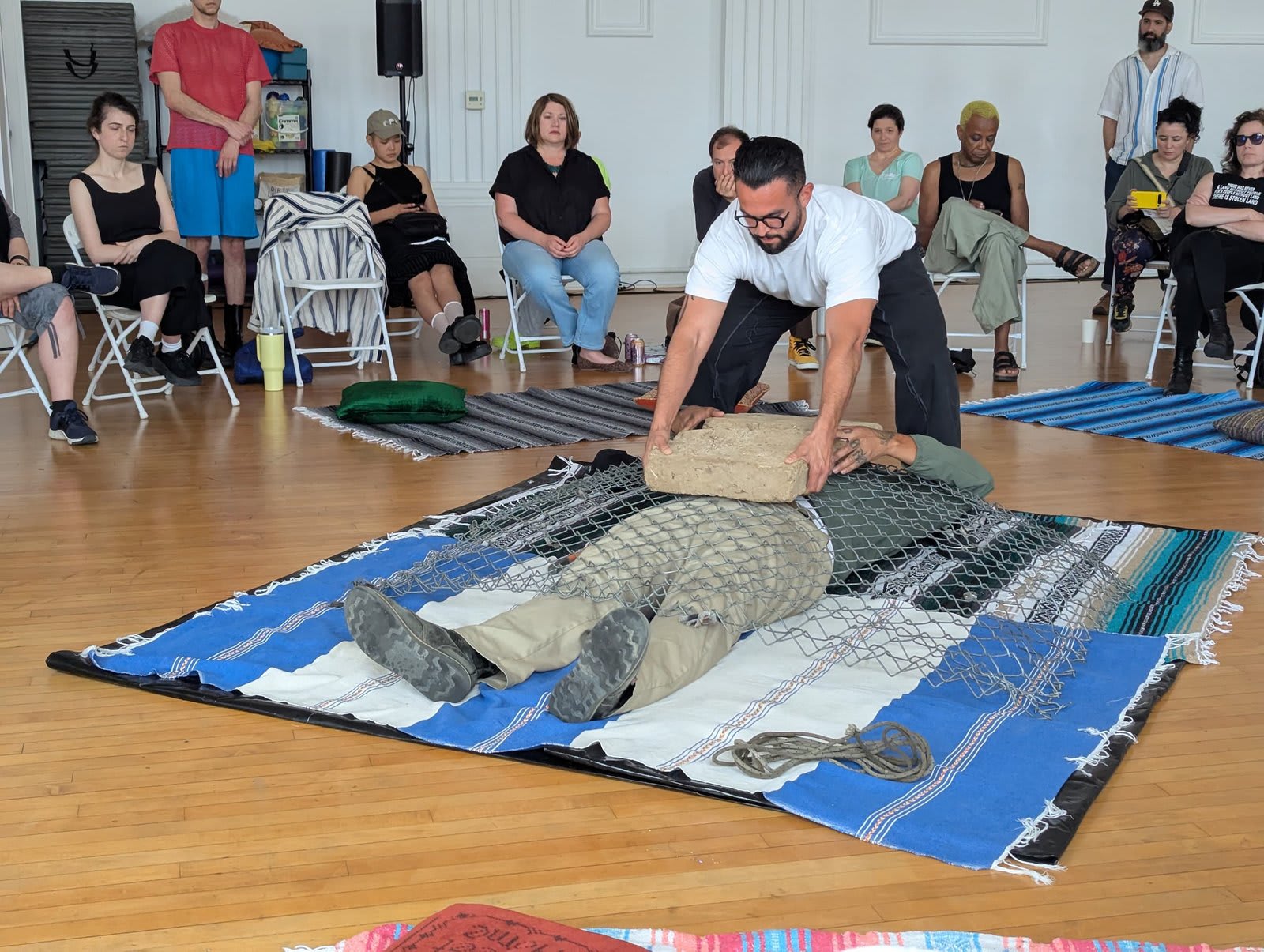
rafa esparza, threshold, performed as part of LAX Micro Fest at Pieter Performance Space, Los Angeles, June 1, 2025. Both photos: Neha Choksi
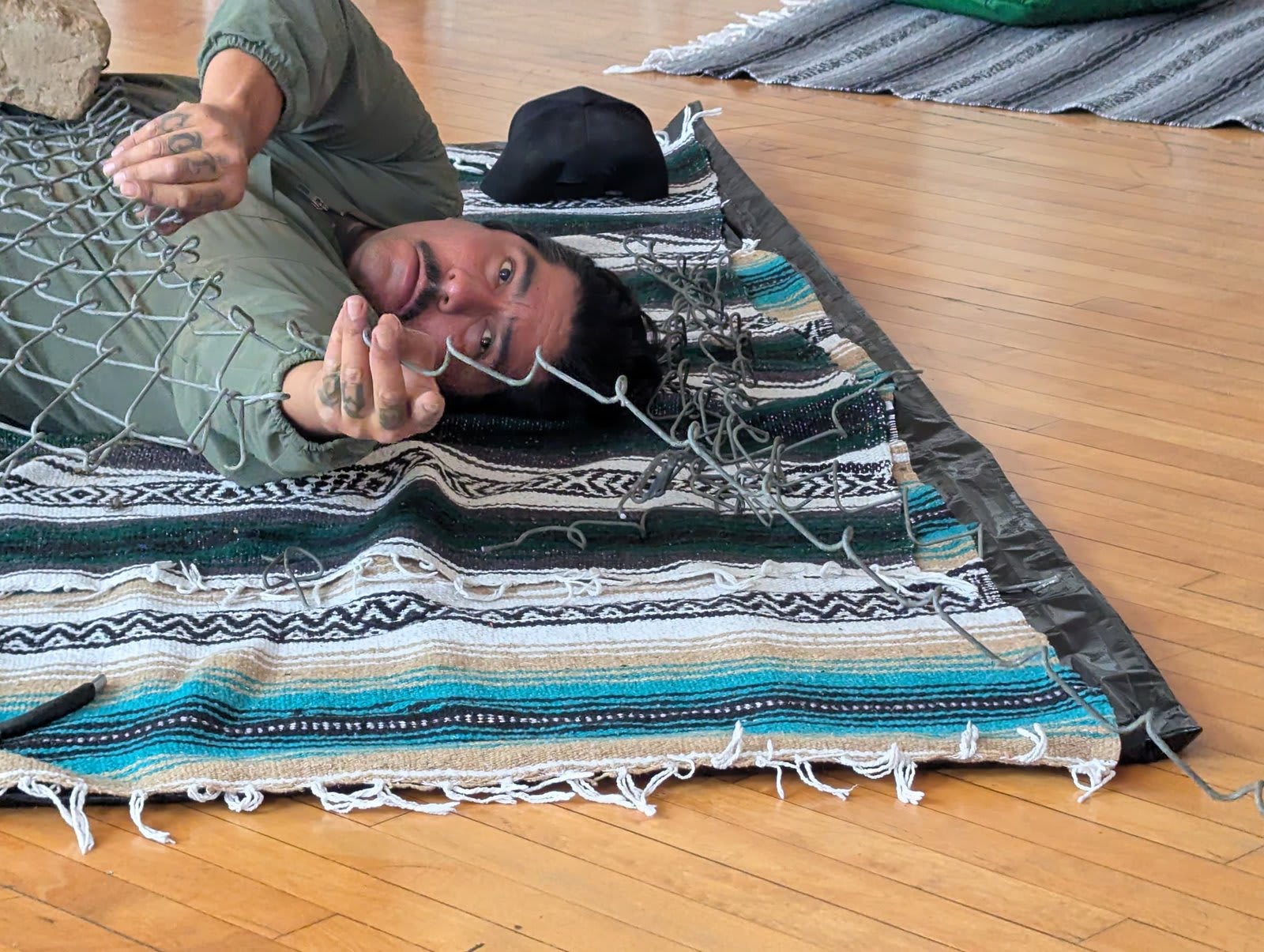
When paired with esparza’s threshold—an embodied, wordless indictment of empire—yaniv’s words gained value as foil and fodder. Lying supine on cozy Mexican blankets, esparza incongruously pulled a blanket of chain-link fencing up to his chest. Instead of sleeping, the body labored. Two adobe bricks, familiar from his other performances, weighed down the metal blanket and kept it in place. The labor of breathing was visible when the gap between the bricks opened and closed. The work was symbolic rather than literal, and insular in its metaphors, if not its references. Fences and immigrants, both looking for home. The wire cutters and pliers were close at hand, and esparza made good work of them for two hours. For an hour he did not cut through his galvanized wire blanket as much as assiduously unweave it. We watched him unfasten and thread each twisted wire out of the matrix. We ingested his labor. We were not complicit, and yet we were not authorized to assist. A careful pile of zigzag metal accumulated. Then, surprisingly, he cut down the center. Now half-lengths of wire were liberated and extracted. Stacking both bricks, he stood atop, holding the fencing like a flag, still undoing. The labor to construct a fence and esparza’s labor to undo a fence were measured against each other. It is as if the economy of migrating and belonging were presented as two halves of an unending effort for self-liberation.
As a generous, inclusive, and curious host, K. Bradford expanded what a live fest could hold—readings and group dancing, post-performance tête-à-têtes, and live bands. This party had many party tricks and party favors, but at times I felt stuck with the party bore. I was thrilled the party happened, nonetheless. At a performance fest where I showed up in celebration of liveness—not just aliveness or lifelines—I found myself querying if a body speaking to another body is enough, if the commitment to live performance needs more than face-to-face presence, something more like an interpellation. Luckily several works showed how collective liveness is summoned, by a magical conjuring of relationships into lived experiences and conversely of sensory experiences into the friction of lived relationships.
[Editor’s note: Edits were made to this review on February 10, 2026.]