Carole Kim’s SQRM was performed in the upstairs black box theater of the Electric Lodge in Venice. It can be simply described as an installation melding technology and live performance. However, what I experienced in the audience was an explosive yet seamless synthesis of image, motion, and sound, designed to evoke an abstract emotional journey, awaken intuitive muscles, and extend openness and the presence of being for an hour. Kim did not offer us a concrete narrative. Instead, she created a heightened state of attention, one in which the audience was moved through curiosity, calm, anxiety, exposure, confrontation, retreat, and exuberance.
The I Is Plural
Carole Kim at Electric Lodge
Review
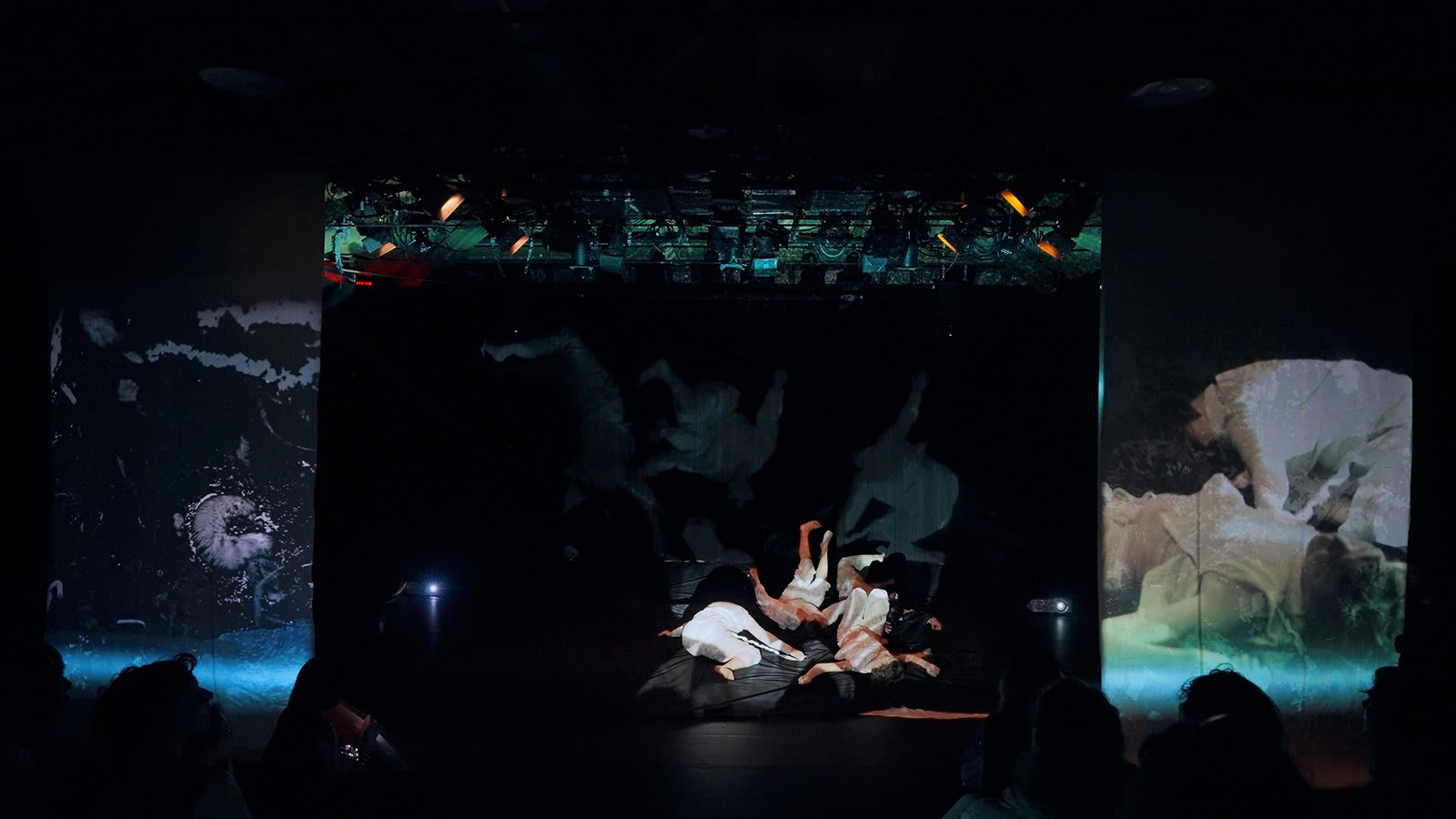
Carole Kim, SQRM, 2026. Performed at Electric Lodge, Los Angeles. Video still © Riley Shen, Theo Rasmussen, Alexandra du Manoir
The program notes describe Kim as exploring “the idea of composite presences, liveness on liveness, to visualize anew how we are plural and how we may coexist as translucent temporal multi-limbed beings joined by unified focused intent.” She does this, in part, through the performance set up and the installation’s design. The audience sat in stadium seating, facing two floor-to-rafters vertical rear-projection scrims flanking the central stage area and one front-projection unit creating a central, cavernous opening into a black void from which the dancers would emerge. Unlike the Great Oz, Kim, with her laptop, dongles, hubs, capture cards, and drives sat exposed on the floor in full view at the feet of those in the first row. From there she could see and feel her dancers, musicians, camera operators, and audience while co-crafting a durational improvisation between humans and software.
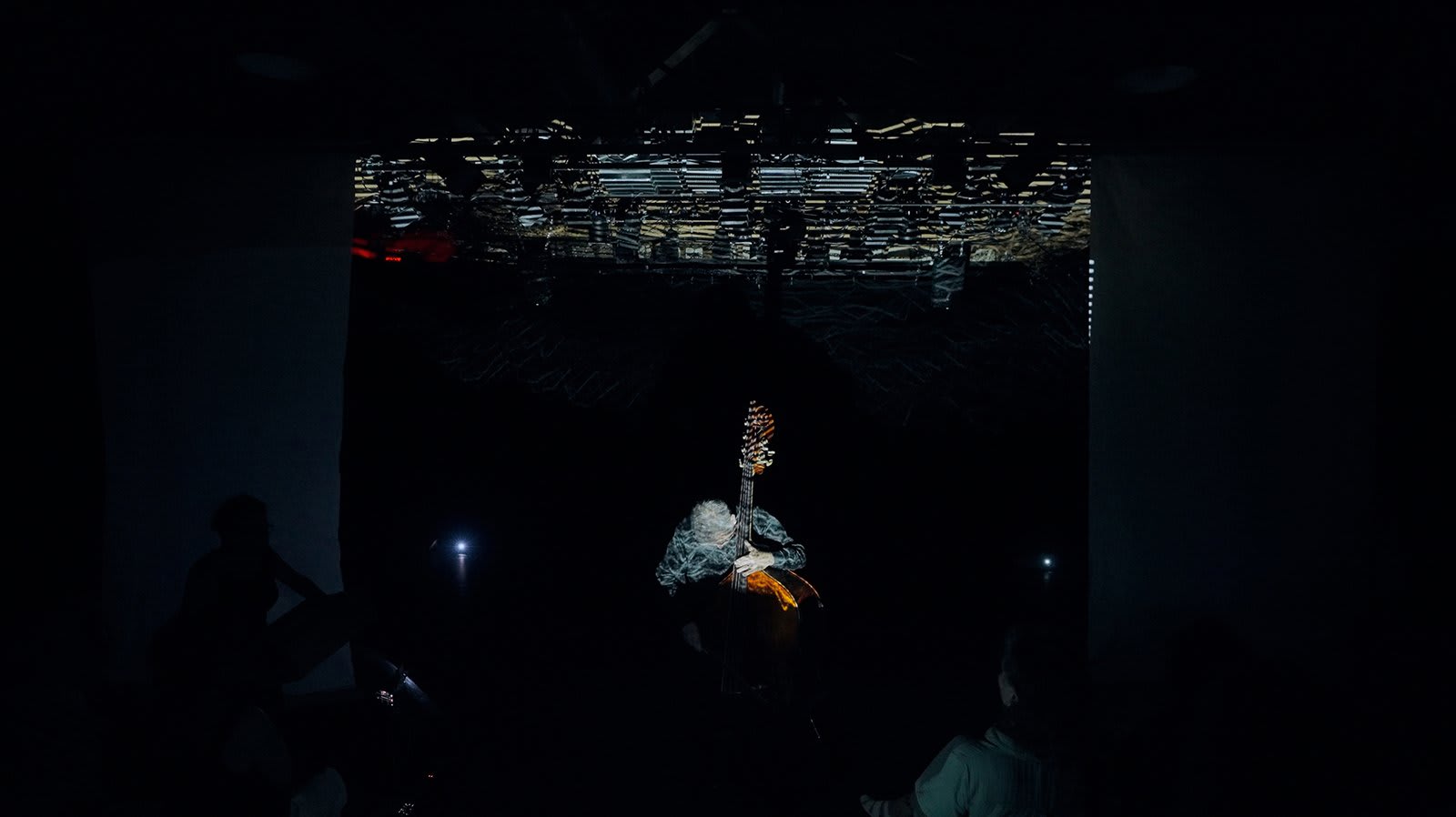
Carole Kim, SQRM, 2026. Performed at Electric Lodge, Los Angeles. Video still © Riley Shen, Theo Rasmussen, Alexandra du Manoir
As an invocation of sorts to draw everyone into the space, the performance began with a man playing an upright bass centered between the two scrims. A projection of a frenetic, fractured pattern of lines rose into the rafters like a cloud of ecstatic electrical energy, then descended over the bassist’s upper body and instrument. The bass started low and slow, then evolved into a faster rhythm, calling forth an unseen chorus of other sound makers who added to the momentum toward a raucous crescendo, followed by silence. The bassist retreated, and a black-and-white projection of a single compost grub resting on top soil activated the two scrims.
While watching SQRM was an intensely visual experience, sound completed the encounter, giving the space depth, pressure, and cohesion. Experimental improvisational music is fundamental to Kim’s process, and in this work, sound became a viscous connective tissue binding image, movement, technology, and presence.
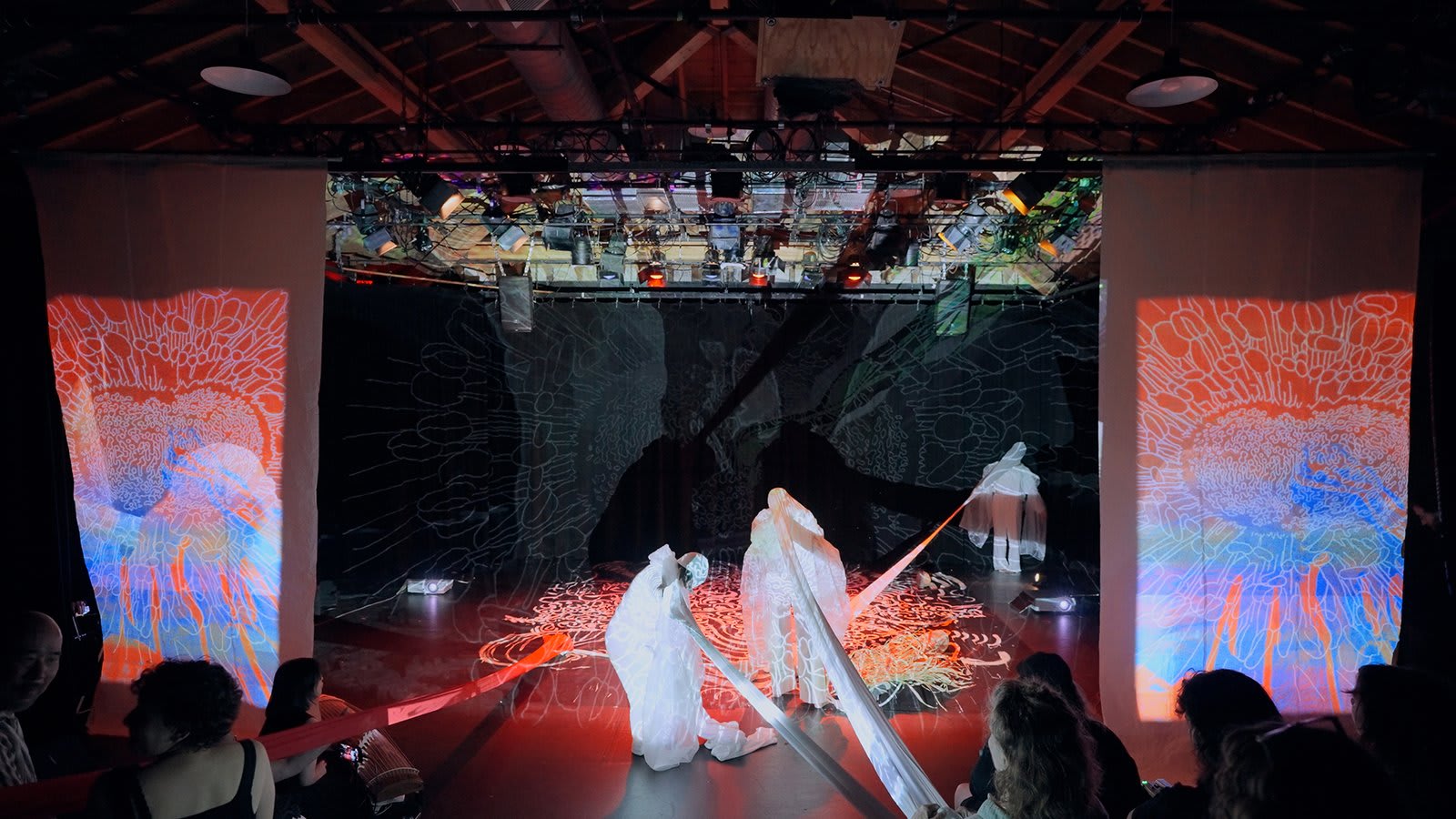
Carole Kim, SQRM, 2026. Performed at Electric Lodge, Los Angeles. Video still © Riley Shen, Theo Rasmussen, Alexandra du Manoir
Kim designed the multimedia installation so a single person could not see everything being performed. It was nigh impossible to differentiate who—musicians, live camera operators, dancers, or Kim—was generating or directing the audio or imagery, because all were actively producing the work in real time. This distributed authorship recalls William S. Burroughs and Brion Gysin’s concept of “The Third Mind”: the emergence of something neither singular nor fully attributable to any one maker.
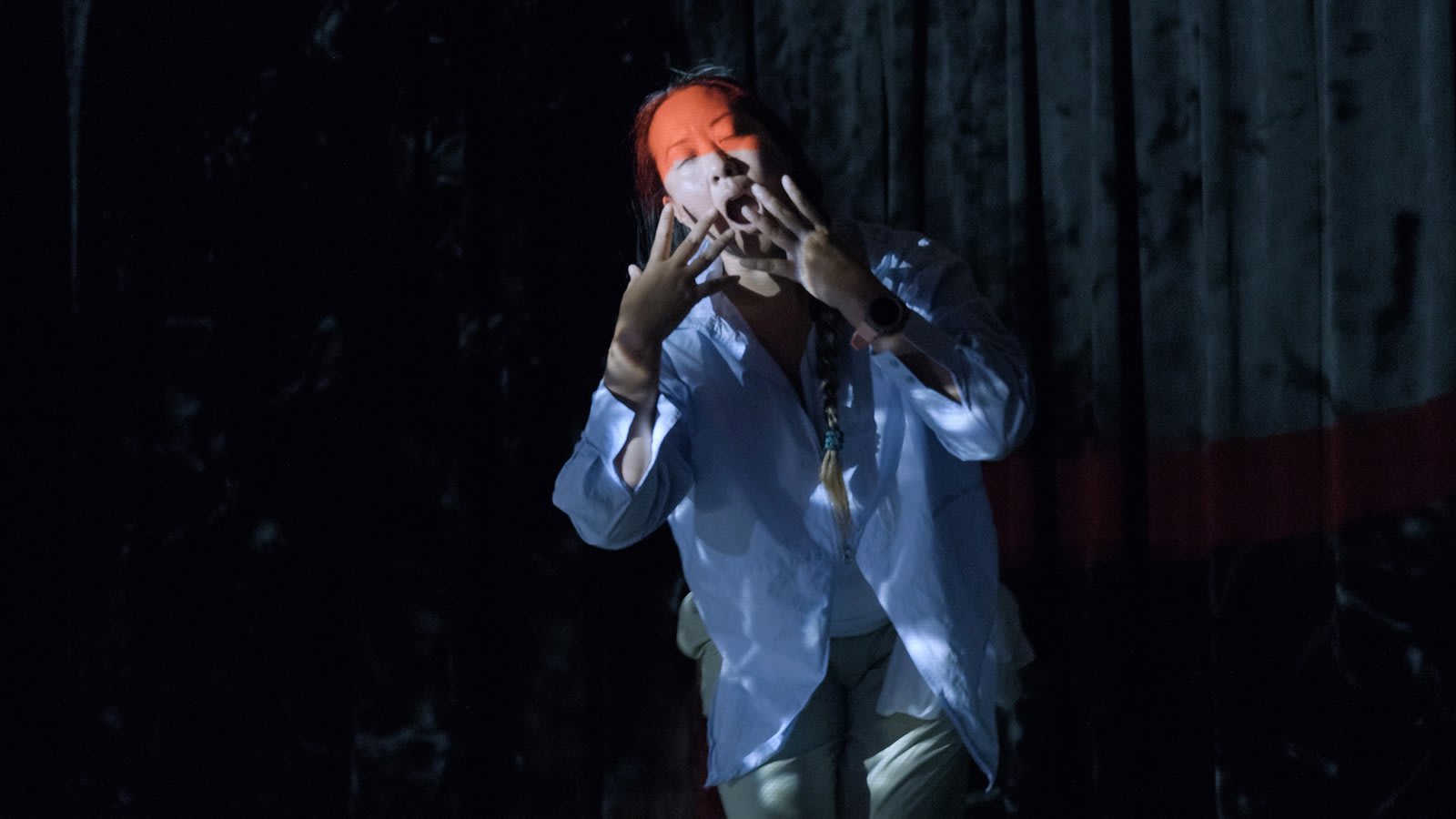
As the four dancers emerged from the blackness and animated the space, they performed for each other, the camera, the musicians, Kim, and the audience. The dancers appeared in varied forms, as mortal beings writhing and squirming, as surfaces receiving projected pattern and light, and as mediated images interpretated and transformed across the scrims. Their projected bodies became black-and-white line drawings, abstracted masses of color, and larger-than-life figures while the image of the grub in soil repeatedly resurfaced between evolving sequences of live activity.
SQRM belongs to a larger lineage of expanded performance practices: from experimental cinema’s effort to pull the moving image off the screen1See the work of mid-twentieth-century pioneering artists such as Takahiko Iimura, Carolee Schneemann, and Robert Whitman, as well as Gene Youngblood’s landmark book, Expanded Cinema (E.P. Dutton, 1970). to postmodern dance’s interest in task and process to the fusion of body, video, and drawing used to create mythic, charged images. Yet SQRM is not merely an example of interdisciplinary performance. It feels rooted in Kim’s own long-standing investment in what happens when the messy, organic, unpredictable physical world meets the possibilities of digital integration.
Although SQRM may be more technically structured than some of Kim’s previous works, its structure does not produce rigidity.2To learn more about the artist’s previous performance and installation work, see Kim’s website: http://www.carole.kim/. Instead, it creates the conditions for freedom. Live-feed cameras, audio-reactive elements, dancers, musicians, and projections operate within a shared conceptual and technical system as the work oscillates between white noise and faint melody, confrontation and retreat, and anxious clusters of squirming bodies becoming a calm, lone individual. Kim establishes the aesthetic circumstances, then allows her collaborators the freedom to insert themselves into the work and co-create its exuberant unfolding. Everyone must remain alert to human and digital input while sustaining the integrity and shape of the piece as it moves toward its agreed-upon end.
The physical materials in the performance deepen the work’s emotional arc. The dancers periodically used three-dimensional and digital representation of white and red ribbons to connect to each other and later to the audience. The evolution of the floor tarps distinguished between movements. One was peeled back to expose a bed of tissue paper, later crumpled by the dancers and folded into the soundscape. The final tarp was a drawing Kim originally had created for her Exuberant Octopus series. At that point towards the end of the hour, the dancers lugged large rocks in and around their environment, then leashing themselves to individual rocks with long strips of stretchy fabric. When the dancers broke out into the audience with the fabric strands, everyone was immediately implicated in the performance, connected to the exuberant bodies and rocks on stage. This final movement gesticulated the interconnectedness of existence and the tension of being simultaneously singular and component.
Carole Kim, SQRM, 2026. Performed at Electric Lodge, Los Angeles. Video still © Riley Shen, Theo Rasmussen, Alexandra du Manoir
Kim refers to being inspired by feminist poet Alice Notely’s “The Descent of Alette,” specifically Notley’s use of quotation marks around each image and her descriptions of being beneath the city, caught between consciousness and dreams, and in a place where things dissolve, reappear, and recombine.3See Alice Notley, “The Descent of Alette,” 1992, https://poets.org/poem/descent-alette-i-walked. SQRM shares this intensity, as if it is both quoting from life and becoming a lived moment. At times, the work’s maximalism risks overwhelming the viewer, but this also feels essential to its force. Kim wants liveness. She wants the body, sound, image, and technology to remain awake to one another. SQRM succeeds because it makes collaboration visible not as seamless agreement, but as a living composite presence: plural, weighted, alert, and still reaching toward exuberance despite the limits of gravity and mortality.