What does a body—artistic, social, political—have to endure today in order to remain calibrated within its traditions and its futures? If calibration1Calibration refers to the continuous process by which a system—technical or embodied—adjusts its internal relations in response to external pressures. From a phenomenological perspective, calibration describes the temporal sedimentation of bodily habits through which perception and action are continuously recalibrated in relation to the world. When applied to bodies, calibration names the accumulated labor through which technique, memory, and constraint are negotiated over time. is understood less as an act of maintaining stability and more as a continual renegotiation of pressures, then what is the role of the body2Here, “body” is understood as an analytic figure that exceeds the dancer’s body while remaining grounded in it; the dancer appears not as an exception but as a particularly intensified site of embodied negotiation. that must hold these shifting balances: the weight of inherited forms, the frictions of historical memory, the demands of the present and future, the politics of visibility and representation? Is this not a labor in itself, a labor that keeps the body’s physical and emotional axis alive under conditions that continually threaten to pull it apart?
On the Movement of Calibration
Lee Yanghee at Performing Arts Market in Seoul
Review
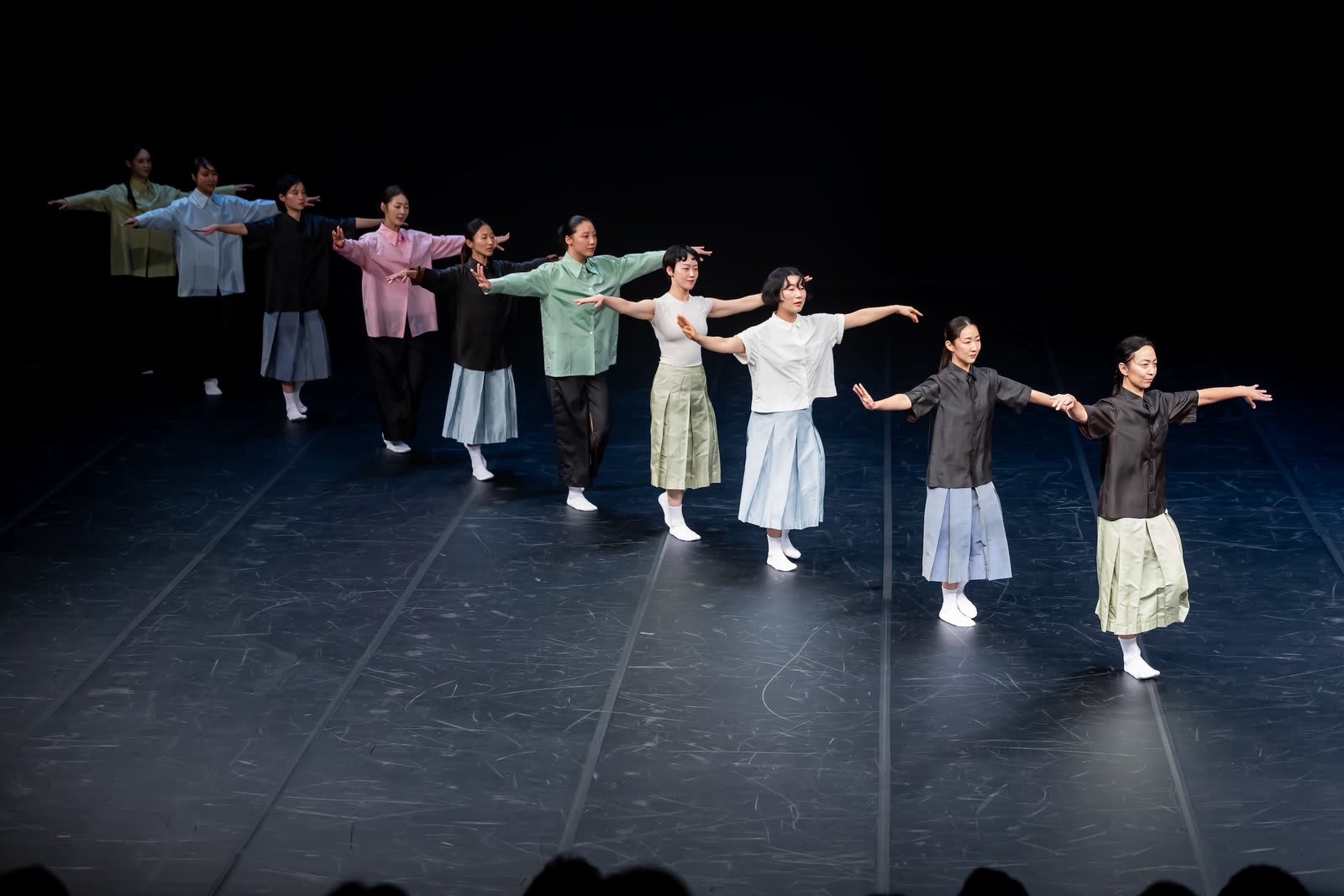
All photos: Lee Yanghee, Shimmering, 2025. Performed at Performing Arts Market in Seoul (PAMS). ⓒ PAMS 2025_KAMS. All rights reserved
On October 15, 2025, on the occasion of the PAMS Choice program at the Performing Arts Market in Seoul, I sat down at the Haneul Round Theater to see Shimmering by choreographer Lee Yanghee. The piece begins long before the stage lights rise. It begins in the years of training sedimented into the ten dancers’ bodies that appear with faces smiling, displaying a state of ease born of long, disciplined conditioning: repetitions, corrections, soreness, the incremental labor through which the body has learned to emit performative presence. “Training a dancer means to invest time and effort to tune the body,” Lee remarked in a previous interview. “The luminous state that a dancer reaches after enduring repetitive and painful training—that, for me, is shimmering.”3“Jeontong-gwa Hyeondae-reul Ieoganeun Peopeomeonseu” (전통과 현대를 이어가는 퍼포먼스) [A performance bridging tradition and the contemporary], Ijeneun Jibang Sidae (이제는 지방시대), posted September 9, 2023, YouTube, 4 min., https://www.youtube.com/watch?v=zHg6fmQ_nOQ. Here, luminosity is not metaphorical. It appears and is felt in the form of physical vibration—ten bodies whose kinetic residue of lived labor leaks out to us, the audience, at the very moment it disappears.
Shimmering is the final work in Lee’s Dance’s Pleasure trilogy, following Gesamtkunstwerk (2019) and Hail (2020).4See Lee Yanghee’s website: https://www.leeyangheestudio.com. Its movement vocabulary draws from traditional Korean dance (shinmuyong) and the aesthetics of 1990s Korean rave culture. Throughout the piece, the performers dance to an upbeat techno pulse under disco lights, entering and exiting the circular stage in various formations—sometimes all ten at once, sometimes in smaller constellations—to perform movements grounded in foundational Korean dance steps such as gibon georeum (the highly stylized basic walking step) or turns characteristic of traditional Korean dance. The dancers oscillate within a tension between citation and embodiment; tradition reveals itself not as a stable repertoire but as a choreography that the dancer’s body wants to test and reconfigure. This tension emerges between what has been learned and what seeks to move otherwise: the lower body and axis remain anchored in a trained Korean dance repertoire, while often the hands and upper body gesture toward a more abrupt, improvisational form similar to what we would witness in club dance.
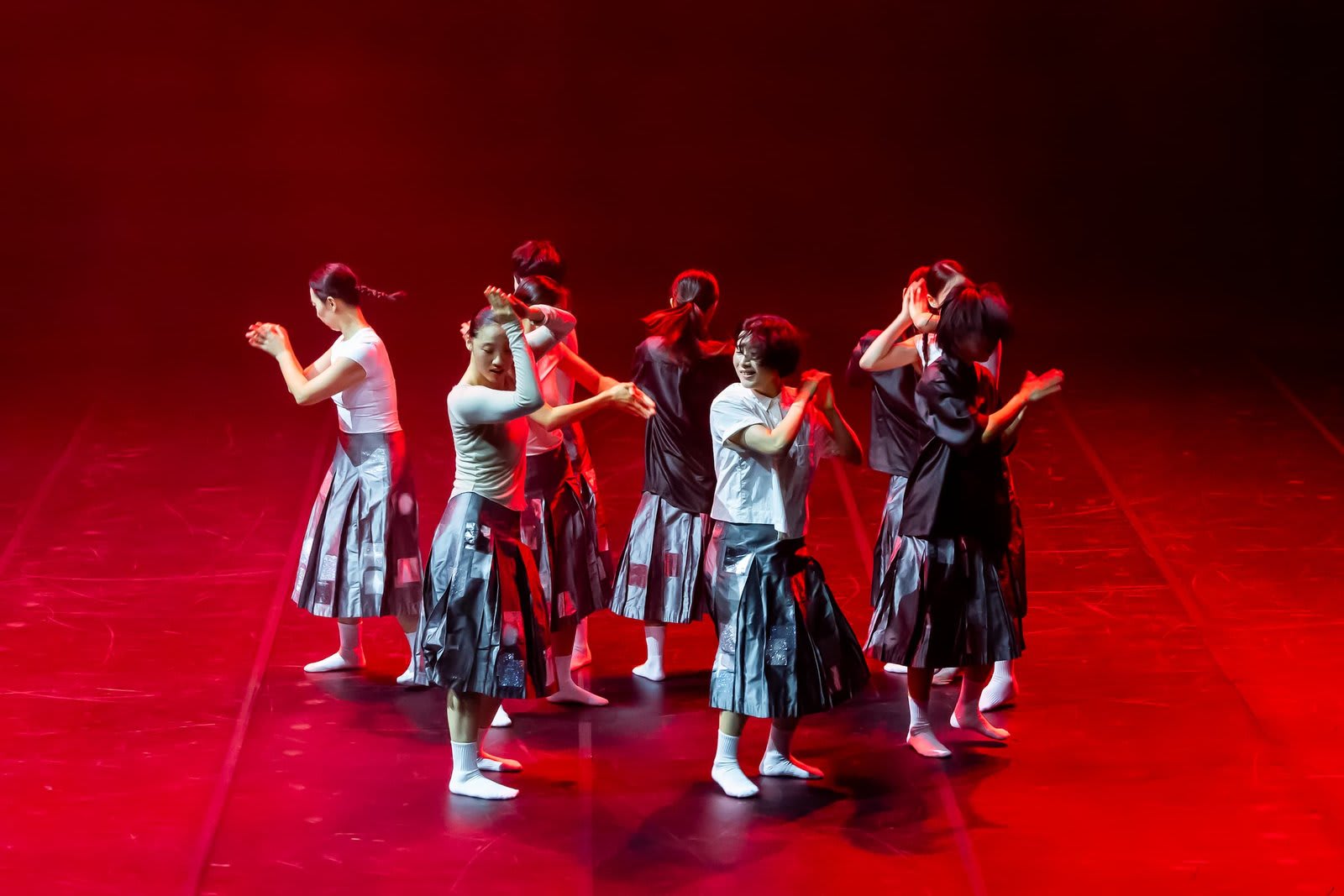
Alongside this tension there is also pedagogical undercurrent visible throughout the piece. This becomes explicit when, for example, the soundtrack falls away for a few minutes and a recorded female voice enters the space, giving cues in the typical tone of a traditional Korean dance teacher. She speaks the rhythmic syllables of jangdan, improvised patterns that structure the length and texture of each movement. Jangdan function not only as counts but also as embodied mnemonics that guide the student through space. In this moment, the dancers respond and translate the cues through their own trajectories. The audience learns that jangdan functions less as strict notation than as a perceptual framework that guides movement without fixing form. And so hearing this voice in the theater reveals an often unseen dimension of transmission; the lineage of this form lives not only in steps but also in the rhythms and breath-patterns imparted by a teacher. The body is, in this moment, calibrated through the sonic imprint of instruction.
The piece reaches its climax when all ten dancers appear evenly spaced and begin spinning in place for a prolonged duration. The image evokes Sufi whirling, yet here the spin is stripped of devotional rhetoric and instead highlights the exposure of pure technique, making it revealing and unforgiving. The audience senses how difficult it is to maintain axis, tempo, and breath without collapse, and in the context of Lee’s open interrogation of Korean classical dance, the scene becomes doubly charged. It is a test of tradition and a public display of vulnerability, where the limits of training become visible in real time.
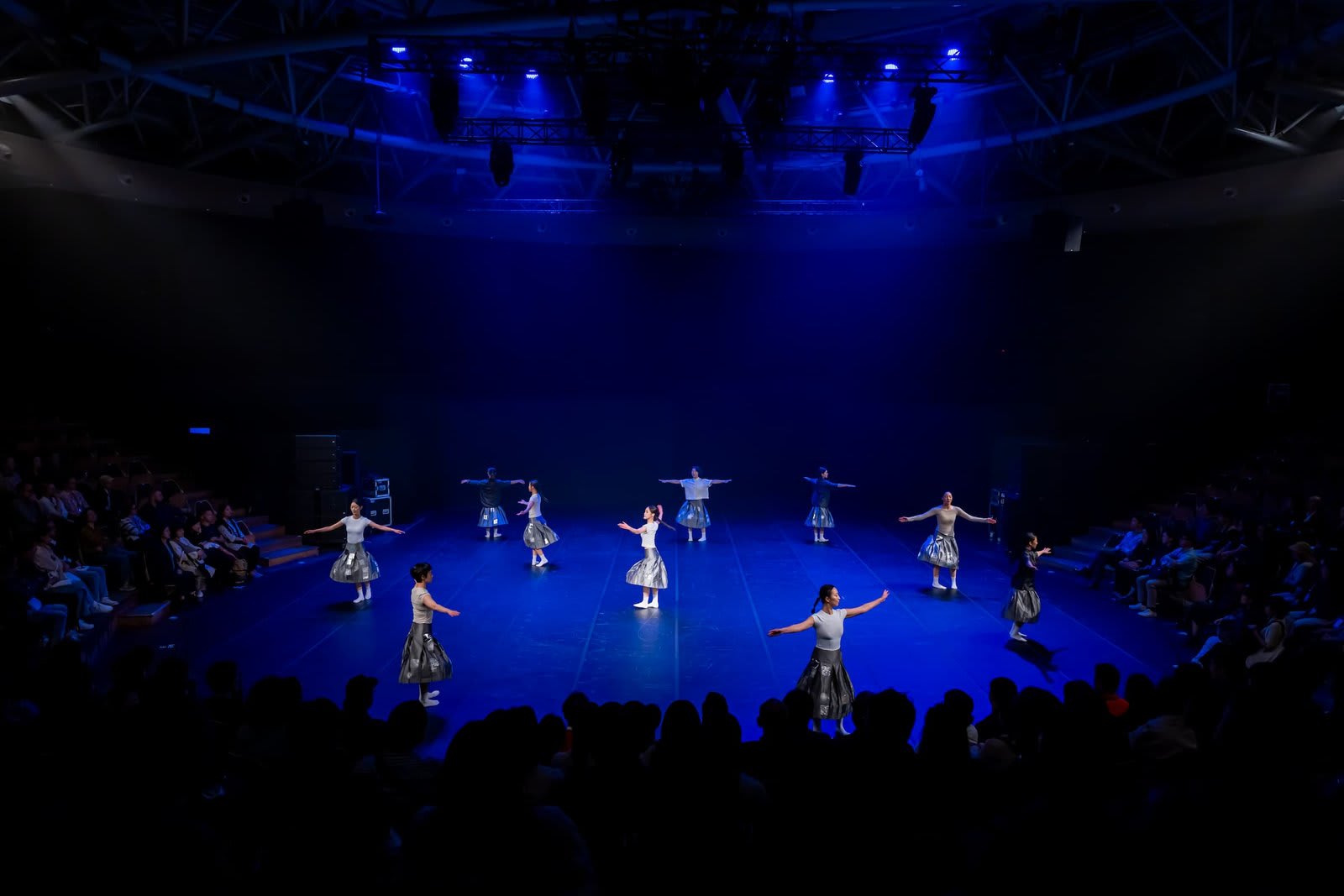
The audience becomes witness to a time filled with continuous micro-adjustments through toes, ankles, knees, pelvis, and ribcage, which render the body’s calibration legible like a choreography of corrections. The sequence feels almost too brutal to watch. It instantly reveals who has internalized timing, who maintains axis, and who carries the longest history of embodied correction. Among the ten performers, Lee’s body—visibly older, steadier, more rhythmically aligned with the techno beat—emerges as the most calibrated. She remains consistent long after the younger dancers begin to compromise shape and axis and slip out of sync with the music. And as the group of ten continues to spin, one observes ten different timelines of training rotating side by side, each body carrying a slightly different lived density of tradition, an archive of discipline, injury, and repair leaking into the space.
Each turn is sedimented labor, micro-transformation, and fatigue memory. If we were to situate this within contemporary art debates around automation, bodily labor, and the politics of preservation, the movement of calibration offers a response to the many artists reexamining the status of craft and disciplined skill as forms of embodied knowledge threatened by digitization. Machine learning systems cannot have exhausted lungs; they do not remember nor choose to carry the asymmetries of a recovered injury or the micro-shakes of long-term practice. The movement of calibration—sometimes painful, sometimes mundane—produces a body that has risked itself repeatedly and refused quick optimization. And only after many years, a time that cannot be accelerated, does it yield this brief shimmering moment in front of a live audience, only to vanish as soon as it appears. It is excess, and none of it is efficient.
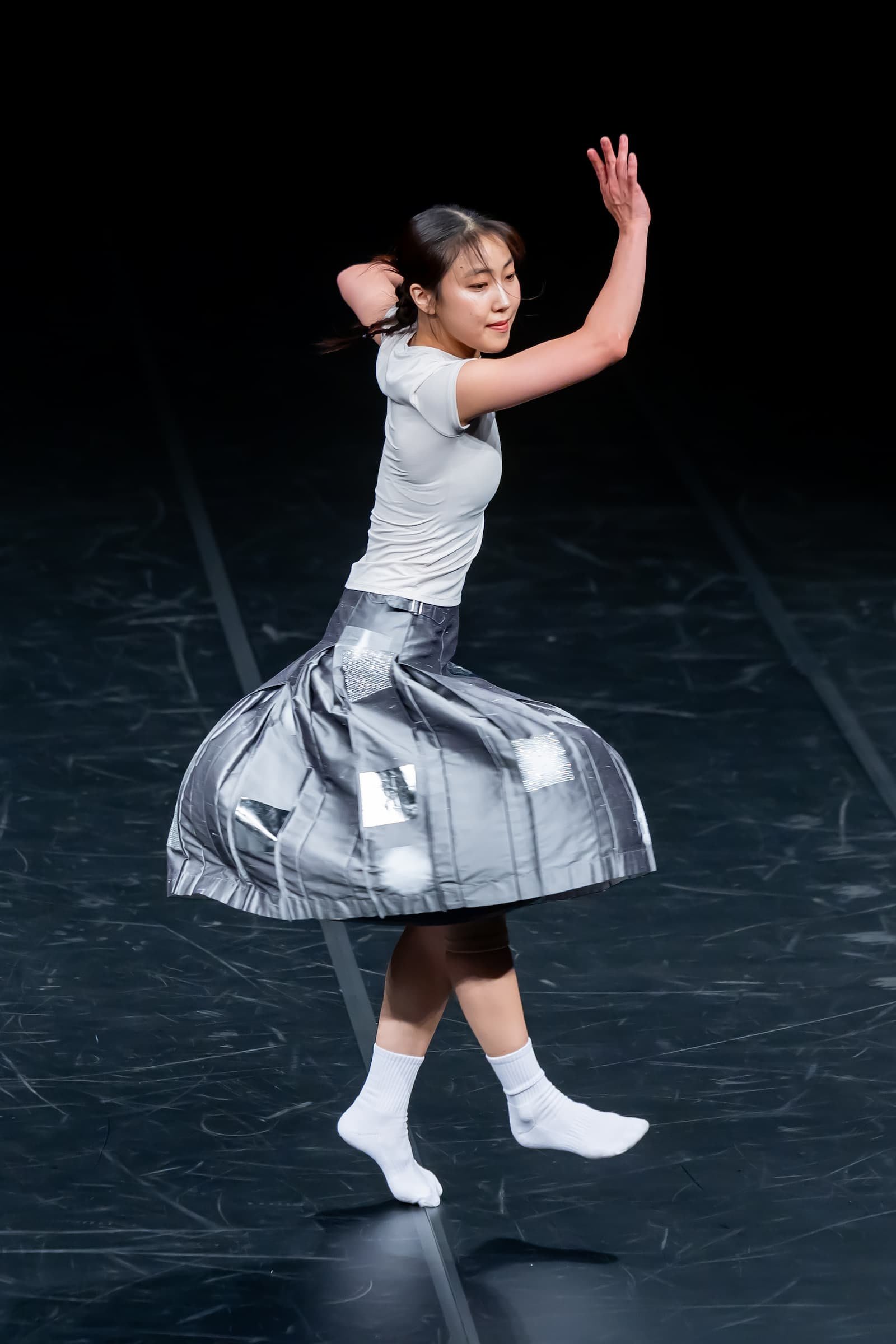
If postmodern choreographers of the 1960s and 1970s—such as Lucinda Childs5See Sally Banes, Terpsichore in Sneakers: Post-Modern Dance (1980; reprint Wesleyan University Press, 2011) and Ramsey Burt, Judson Dance Theater: Performative Traces (Routledge, 2006). and Yvonne Rainer6See Yvonne Rainer, “A Quasi-Survey of Some Minimalist Tendencies in the Quantitatively Minimal Dance Activity Midst the Plethora, or an Analysis of Trio A,” in Minimal Art: A Critical Anthology, ed. Gregory Battcock (1968; reprint Dutton, 1995), 263–73.—produced a structural shift by reorganizing dance at the level of compositional logic and technical value, Shimmering stops short of that threshold. These predecessors’ interventions did not merely restage inherited vocabularies under new atmospheres but redefined what could count as dance structure in the first place: through reduction, task-based movement, repetition, and the refusal of virtuosity as the primary measure of form. Lee’s work, by contrast, leaves the technical grammar of tradition fundamentally intact. Its experimentation unfolds at the level of sensorial framing and stylistic juxtaposition rather than structural redefinition. What results is not a rewriting of the traditional dance grammar, but a sharpened visibility of its constraints and costs.
Shimmering appears to loosen the frame of Korean classical dance by replacing court music with rave-like techno; infusing the upper body with vibrations and shaking reminiscent of club culture; introducing disco-like lighting; and dressing dancers in oversized tops and long skirts that gesture toward modernity. These elements signal a willingness to recompose tradition within contemporary sensorial regimes. Yet the technical core remains rigorously traditional. Footwork, tempo, axis, and lower-body discipline follow established structures with little deviation. Unison dominates. The choreography demands uniform execution regardless of individual differences. The teacher–student distinction becomes visible because precision is not stylistic but infrastructural; it is what allows the tradition to appear at all.
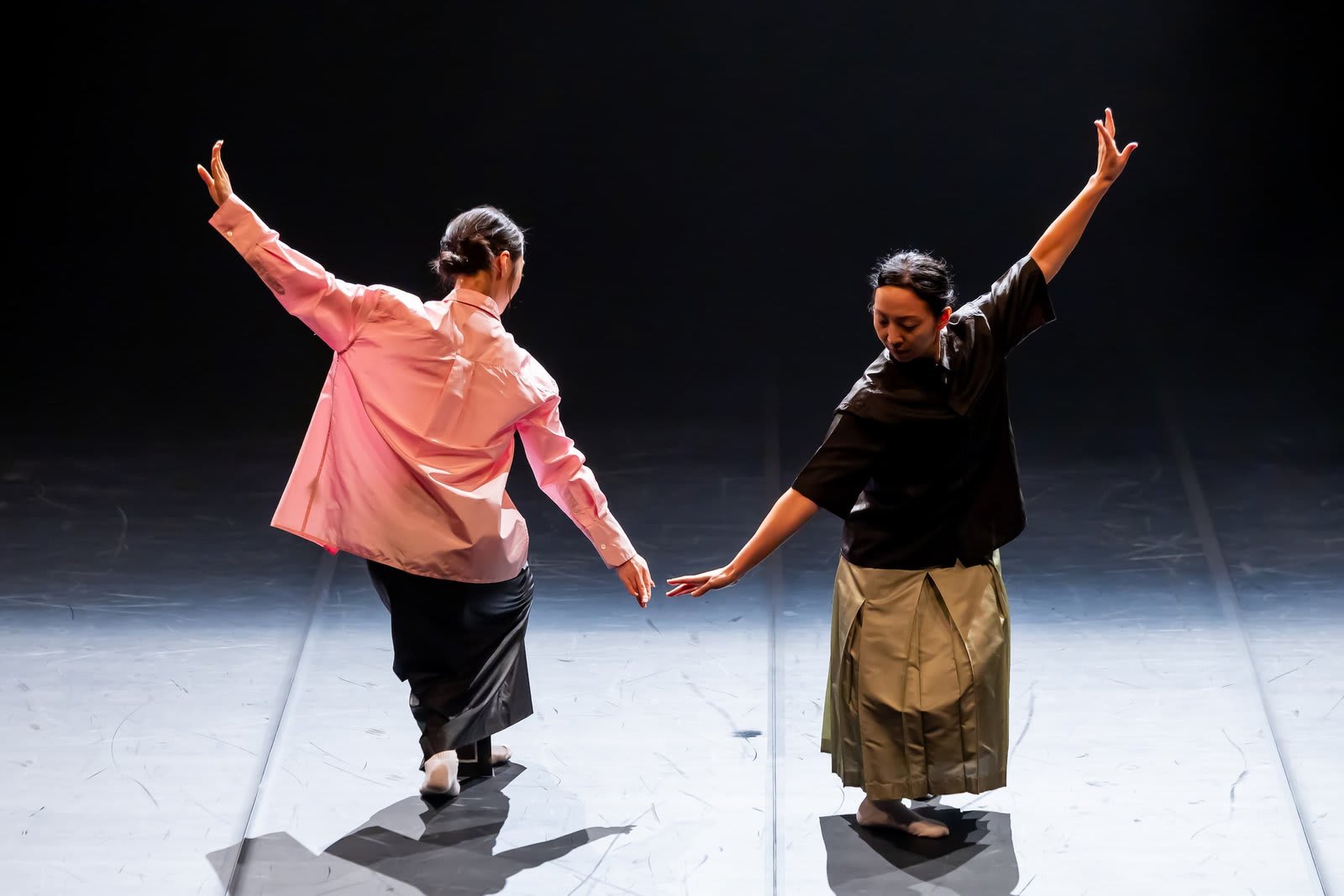
What the work reveals is that calibration is not a fixed state but a continuous movement, an ongoing negotiation between what the body must surrender in order to remain between past and future. The choreography confronts the difficulty of sustaining embodied knowledge within systems that prefer citation over inhabitation, reference over risk. The piece invites admiration but also leaves us with a more unsettled question: What does it cost a body to embody tradition, rather than merely allude to it, in a world increasingly structured around disembodied forms of preservation?