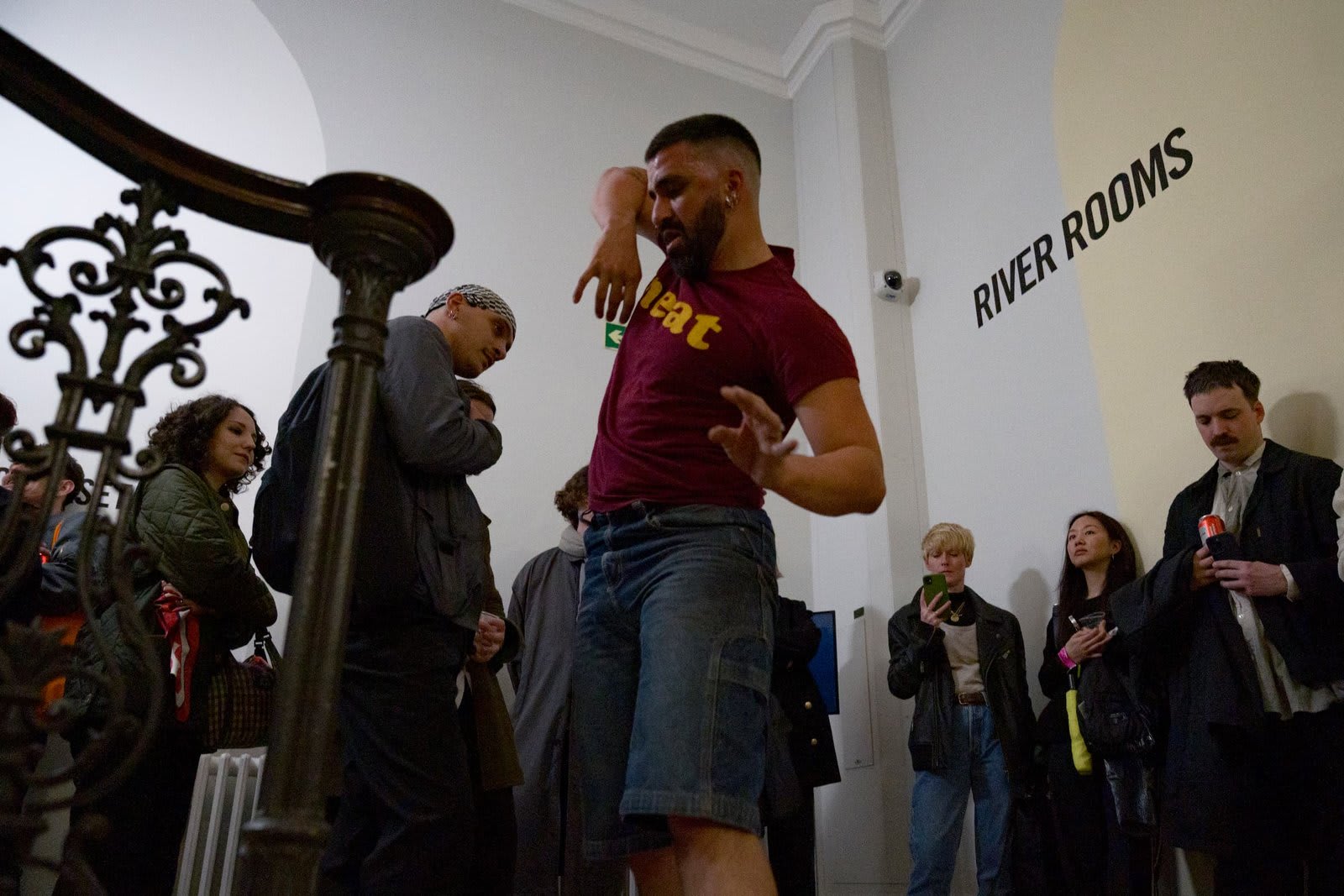
Like many anticipated moments in life, Relay by Hannan Jones and Samir Kennedy started unannounced and potentially unnoticed. Dressed in baggy jorts and a T-shirt emblazoned with the word “meat,” Kennedy jostled through the waiting crowd queuing patiently in a hallway at the foot of a grand staircase in Somerset House Studios. At first, he could easily have been mistaken for an overly boisterous attendee. Gradually his movements became more aggressive and athletic, verging on violent, until he repeatedly slammed his body into the wall. As he punctuated more stylized vogueing movements with this virtual self-flagellation, watching him became increasingly jarring and uncomfortable. His campy moves and trendy outfit, combined with these punishing actions, evoked a barely contained inner conflict. As the doors opened to the performance, Kennedy entered the large neoclassical space with the audience, circulating the room in a way that felt almost belligerent, kicking chairs out from under visitors as they attempted to sit. It made for an unsettling entry. His vaguely threatening and imposing presence built a palpable tension, enacting a confusing and fractious confrontation of performative and subconscious masculinity.
Feeding Back
Hannan Jones and Samir Kennedy at Somerset House Studios
Review
Hannan Jones and Samir Kennedy, Relay, 2026. Performed at Somerset House Studios, London. Photo: © Anne Tetzlaff
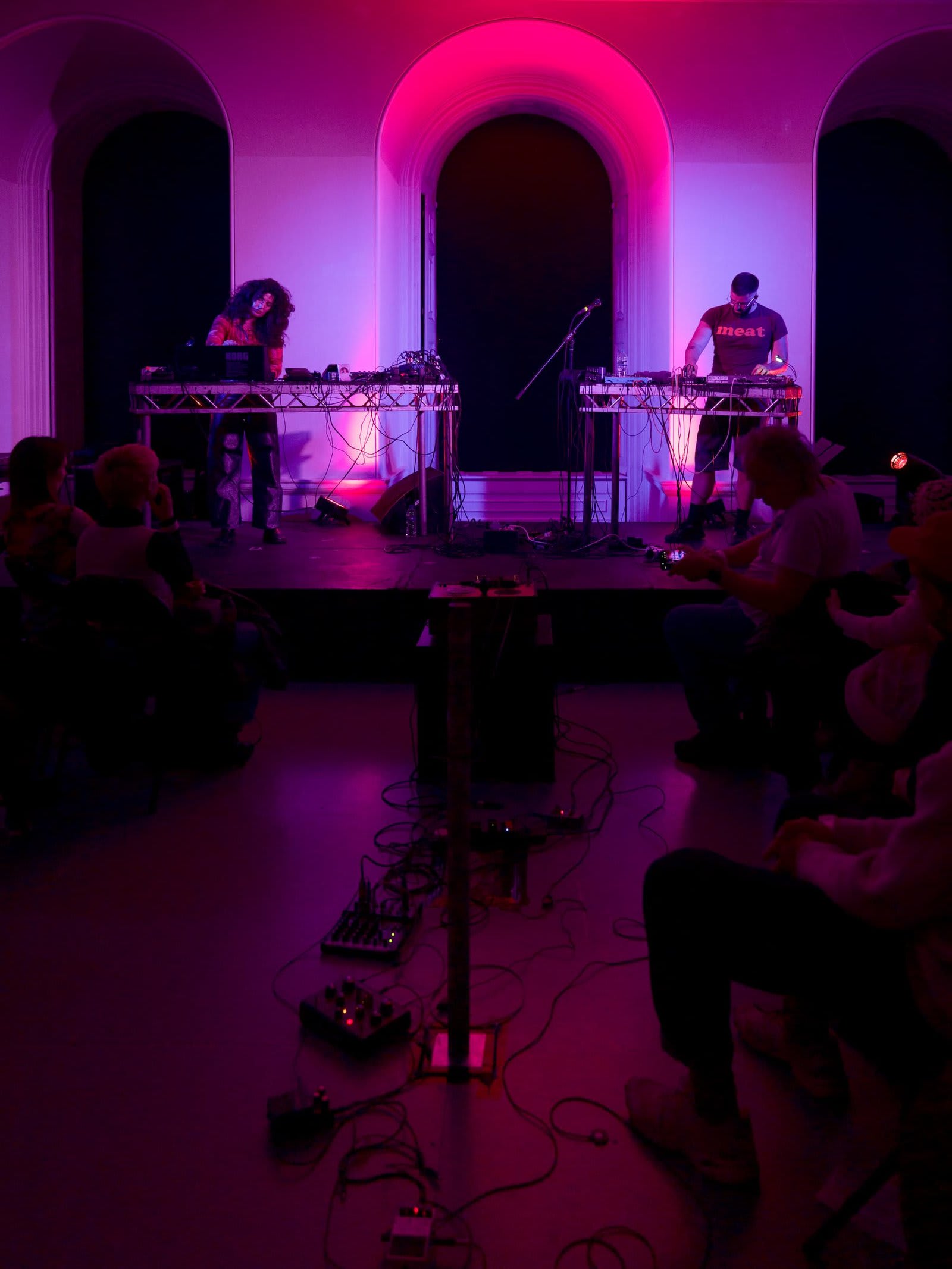
At the center of the room, positioned in front of the stage and between the seats, sat a spinning reel-to-reel player, its vibrating ribbon of tape rotating around a floor-mounted industrial pole. On the floor beneath the machine was a jumble of contact mics, pedals, XLR cables, and Jones on her hands and knees, performing multiple manipulations. Accompanying Kennedy’s and Jones’s physical exertions was a muddy, scrambled soundtrack full of reverb. Gradually, Kennedy slid to a corner of the room. Curled on the floor, he wailed into a microphone—the haunting, sad vocals echoed through the space, as though heard from another room or in a dream. From this chaotic intro and messy dissonance something discernible started to emerge: a promising, looping beat.
Relay is a series of iterative performances by Jones and Kennedy, framed in the handout distributed at the event as “a sonic environmental container which interrogates the complexities of the artists’ shared Algerian–British identities.” Using material from their personal archives of music and found sounds, combined with live recordings of the room, the pair perform an improvised composition intended to “interrogate the infinite flux and construction of fragmented identities and the dissolution of the self.” At Somerset House Studios, as the performance evolved from its opening promise, it meandered somewhat through a lengthy experiment in sonic materiality. The initial aesthetic interest of the artists’ movements and the shambolic setup of myriad cables and analog sound equipment gave way to mutual absorption in their respective decks. The resulting looping and ambient soundtrack and minimal staging, which might have otherwise felt meditative, in reality was slightly underwhelming in contrast to such a captivating and wild start. Although not specifically identified, vocals and musical snippets emerged and the cassette case propped on Jones’ set-up suggested an example of their formative cultural heritage. While the samples and relays merging past and present, here and there, culture and geography, physical and immaterial, were conceptually interesting, in practice they were somewhat limited to an exercise in the dynamic of background and foreground. Perhaps this was the point. In embracing multiplicity and live collaboration, there is a necessary ebb and flow, a pushing of boundaries and acceptance of risk.
Hannan Jones and Samir Kennedy, Relay, 2026. Performed at Somerset House Studios, London. Photo: © Anne Tetzlaff
The performance gained traction when Kennedy returned to the microphone with a baleful vocal that sounded like a lament, before he descended into guttural tics and fragmented and brutal utterances, the physical exertion of which was palpable. These vocal experiments became a visceral material that was looped into the overarching soundtrack, dissolving until its humanity was no longer recognizable. Jones finally exited the stage deck, and kneeling once more on the floor, she gradually used the magnetic mic to erase the spinning tape, silencing the sound they had built together. Once the tape was blank, they each took a turn in executing a two-part switch off of the reel-to-reel machine. The final sound of the performance was Jones’s impromptu laugh when she slightly fumbled. This charming rupture made visible the intimacy between the pair, and was most welcome after a performance where they worked in parallel, their collaboration largely invisible and impenetrable to the audience, existing solely in the sonic combination. It was a poignant end to a performance that oscillated between entirely captivating and confronting, and perhaps too forgiving in its embrace of experimentation. While the combination of experimental sound, voice, and movement have a strong lineage—from Meredith Monk and Charlemagne Palestine to Jennifer Walshe and many others—the extremity of Kennedy’s embodied performance was striking; perhaps a stronger balance or entwining of this aspect will evolve as this collaboration does. Relay was most powerful during the chaotic and fragmented peaks at its start and end, where Kennedy and Jones themselves were physically at the fore. It was at these moments the performance most successfully realized its ambitions to expose the complicated and multiple nature of identities that span disparate geographies and cultures.