When one is watching an eight-hour durational performance, when does one use the bathroom? How do the performers manage during this extended stretch of time? A couple of days before Resurrection #6: another death divination, Vietnamese dancer and performance artist Anh Vo posted an Instagram story inviting the public and mentioning that the last time they put their body through a similarly long and repetitive work, they ended up with runner’s diarrhea. Vo’s funny and grotesque joking actually points to a larger question underlying their artwork: Who and what does the body involuntarily take in and expel out?
Risking the Runs
Anh Vo at PARTICIPANT INC
Review
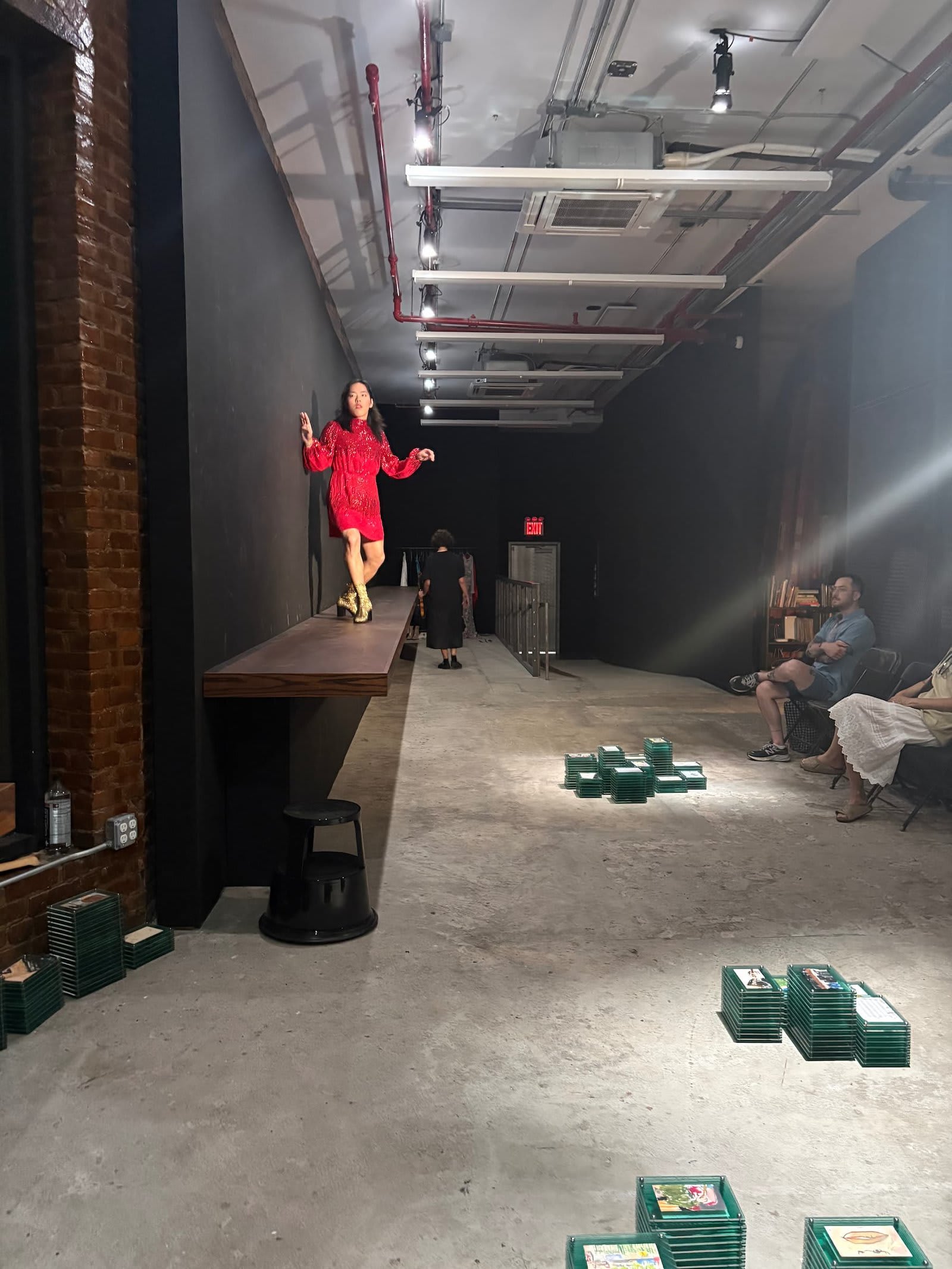
Anh Vo, Resurrection #6: another death divination, 2026. Performed at PARTICIPANT INC, New York City, in conjunction with the exhibition Song and Sex: Before the Revolution, May 10–June 21, 2026. Photo © Courtney Lau
Resurrection #6 is one of seven performances that are part of Vo’s exhibition, Song and Sex: Before the Revolution, curated by Alhena Katsof at PARTICIPANT INC on the Lower East Side. The eight-hour performance aims to highlight the body’s porosity by rendering it into a vessel for the spirits of Ca Trù, a form of northern Vietnamese chamber music with a murky history of vice. On a hot and humid day, I step into PARTICIPANT INC and am transported to a hazy world where I find Vo already in motion. In a glimmering red sequin dress and sparkling gold square-heeled boots, the artist stands on an elevated wooden ledge that stretches across the narrow room like a runway. Evoking the kind of movement emerging from the Judson Memorial Church in the 1960s, they rove up and down the ledge, repeating a simple phrase of steady steps and half turns away from the wall. They do this over and over until their movement collapses into itself. Eventually, Vo begins to sing and stutter a chant that is reminiscent of choreographer Miguel Gutierrez’s DEEP Aerobics (2007–17): “This is / This is not a show / This is not a show / You don’t have to know.” As Vo moves on top of the platform, musician Marija Kovačević walks on the floor in parallel with them, scraping a violin against the outer edge of the platform. She traces the wood grain with all parts of the instrument, from the neck to the body to the strings. After following Vo for a few moments, she trails off, finding new ways to degrade and grind the violin against other surfaces in the space. In contrast to the even rhythm of Vo’s repetitive stepping and campfire song-like singing, the violin emits dissonant sounds of scratching and screeching that grow in intensity, leaving me queasy. Already feeling nauseated one hour into the performance, I swiftly shuffle out of the exhibition space in need of a break.
When I return, the performers have shifted into a new phase and are now rehearsing Ca Trù. Sitting with legs crossed on the opposite end of the ledge, Vo sings “to hold / to hold a sign / a sign,” a phrase that transforms into a broken sound between a moan and a whimper while they drum a syncopated rhythm with a phách (a percussive instrument consisting of a small wooden platform and two sticks) as Kovačević and composer gabby fluke-mogul play their violins. The first part of the performance initially appeared as postmodern dance, but upon closer observation, Vo’s chanting and clacking heels paired with Kovačević’s manipulation of the violin indexes Ca Trù’s foundational elements: voice, drum, and lute. Afterall, Song and Sex is the culmination of a year-long project in which Vo apprenticed with Ca Trù master musicians, Vũ Thuỳ Linh and Phạm Đình Hoằng.
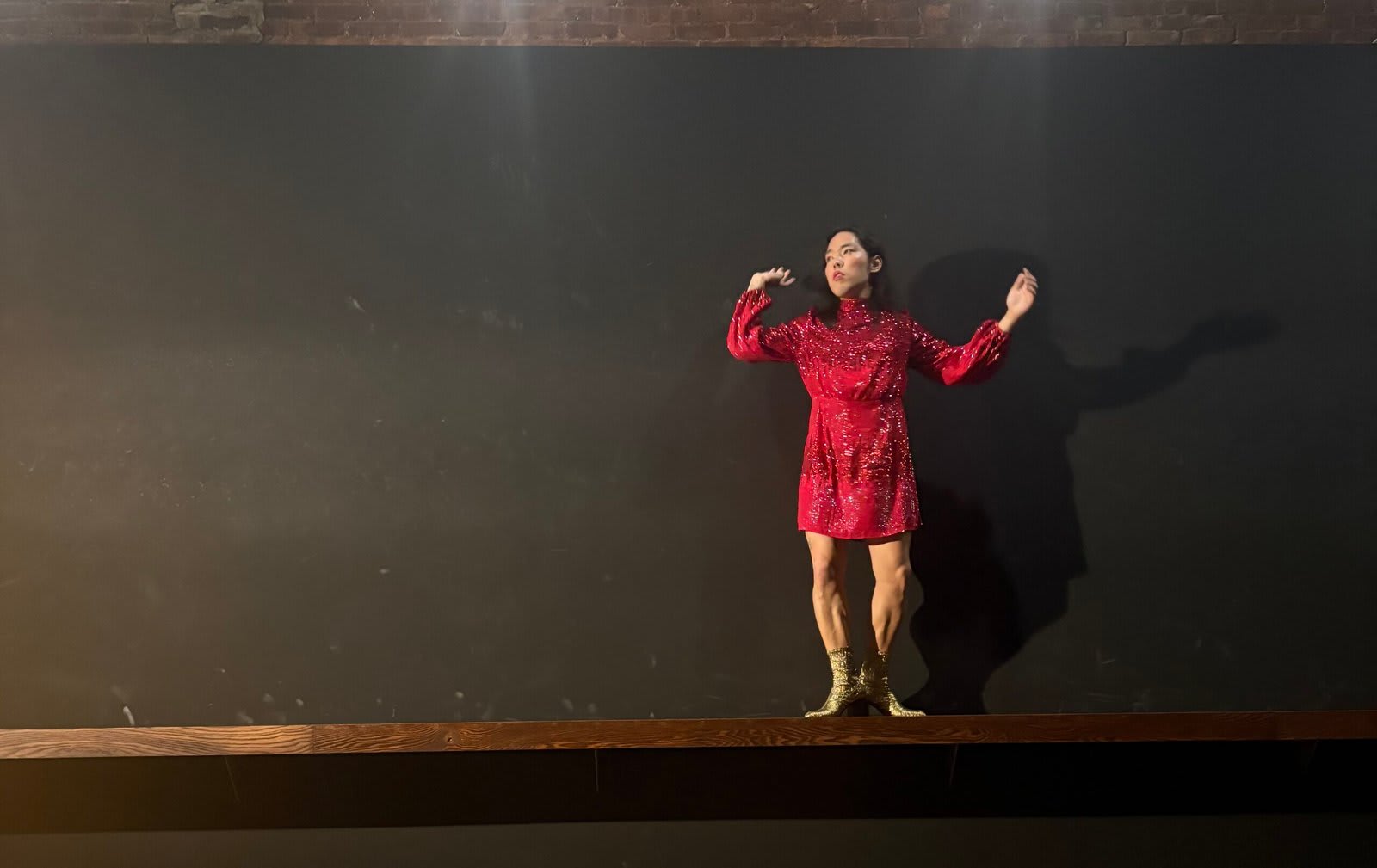
Anh Vo, Resurrection #6: another death divination, 2026. Performed at PARTICIPANT INC, New York City, in conjunction with the exhibition Song and Sex: Before the Revolution, May 10–June 21, 2026. Photo © Courtney Lau
Over the course of eight hours, the performance swings wildly between what seems to be two modes. In one, Vo utters and hums words and sounds, playing the phách nearly in a trance while still strictly adhering to the conventions of Ca Trù. In another, the artist deforms Ca Trù, stretching its conventions by turning melodic singing into absurd chanting and traditional percussive rhythms into measured stomping. Vo—alongside Kovačević, fluke-mogul, violinist Jessica Pavone, and dancer Kristel Baldoz—plays to each mode until they have reached exhaustion, before matter-of-factly moving across the space and starting again. As the performance continuously shifts, Vo sits with “the ambivalence between inheritance and experimentation, devotion, and irreverence.”1PARTICIPANT INC, Anh Vo, Song and Sex: Before the Revolution, urated by Alhena Katsof, press release, May 10, 2026, https://participantinc.org/content/2-seasons/2-season-24/4-anh-vo-song-and-sex-before-the-revolution/anhvopr.pdf After coming to power in the mid-twentieth century, the communist government of Vietnam suppressed Ca Trù due to its ties to prostitution and opium culture. Contemporary efforts to preserve Ca Trù as a piece of UNESCO Intangible Cultural Heritage often disavow the dynamic histories of sex that shape its practice. If the current state tells a story about Ca Trù that promotes national resilience through the body’s capacity for virtuosic performance, then Vo’s work defaces this sanitized narrative through relentless expulsion. As the performers endlessly dance and chant with glistening bodies and trembling voices, they seem to enter into altered states of consciousness and a heightened sense of intimacy that resurrect, rather than reject, the intoxicating histories of drugs and sex that haunt Ca Trù.
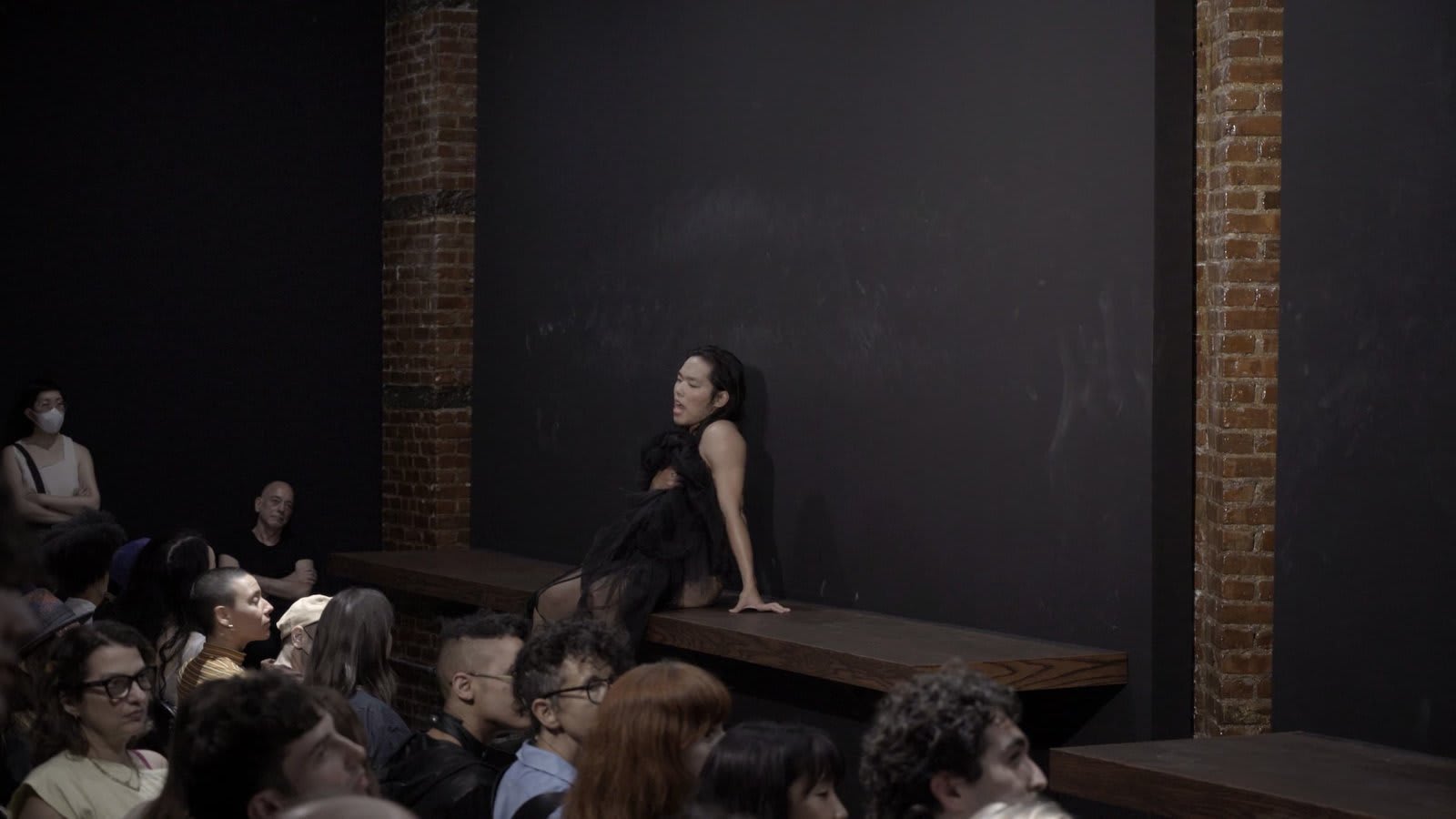
Anh Vo, Resurrection 7: sex on sundays, 2026. Performed at PARTICIPANT INC, New York City, in conjunction with the exhibition Song and Sex: Before the Revolution, May 10–June 21, 2026. Video still © Itziar Barrio
Throughout the performance, my eyes wander around the exhibition to a drawing by Kyle b. co. of Vo’s time studying Can Trù with text that reads, “REPETITION DESTROYS YOUR BODY BUT IT PUTS YOU IN A CLOSER RELATIONSHIP TO GOD.” By the end of the durational performance, the artist’s chanting voice cracks open, revealing a profoundly vulnerable body that disrupts modern fantasies of bounded selfhood. With blush melting off the face, worn down and exposed, Vo becomes a receptacle for the gods of Ca Trù. Whereas the performers engage in constant acts of doing, some audience members, including me, commit to watching the performance for the entire eight hours, which becomes a durational performance in itself. Over the long haul, in between feelings of boredom, fatigue, discomfort, anxiety, and hunger, I experience moments when Vo’s vulnerability overcomes me, pulling me in like a dangerous undercurrent to reveal glimmers of ecstasy.