
Gathered in a semicircle around a freestanding projection screen, audiences watch as the film approaches its climax. A digital figure moves through a rendering of the Venetian pavilion in which we are sitting, only for the image to then show the same pavilion contained within itself at a smaller scale. A second figure walks into frame and is shown picking up a small puppet, making it speak to pose increasingly existential questions, as though self-consciousness may provide a way out of the mise en abyme. Instead, the image folds inward once more, revealing another Russian doll version of our setting.
Ventriloquizing the Master’s Tools
Eunju Hong at Palazzo delle Prigioni
Review
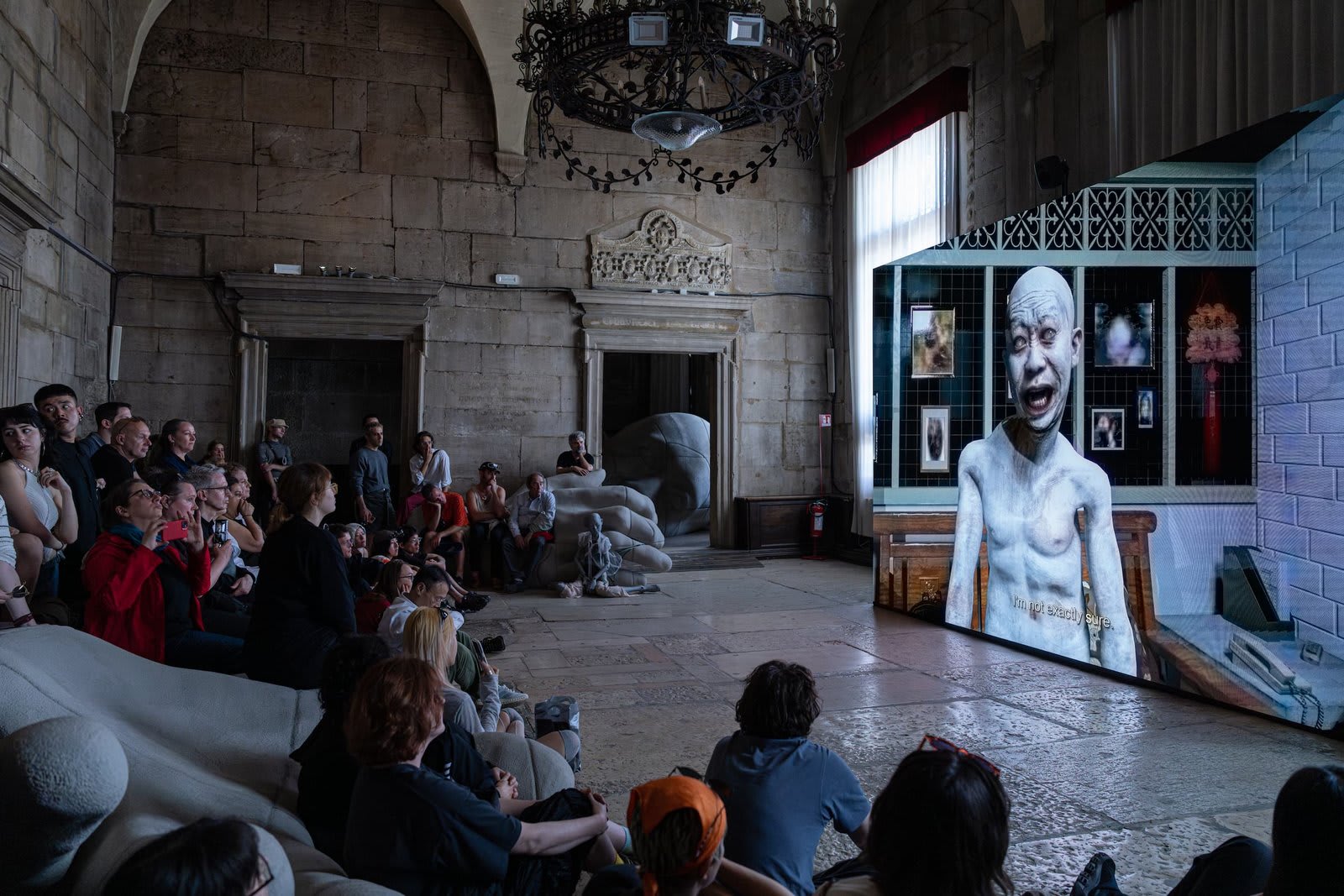
Eunju Hong, She seemed devastated, when I was weeping with joy, 2026. Performed alongside Li Yi-Fan’s Screen Melancholy, 2026, at Palazzo delle Prigioni, Venice, as part of the 61st Venice Biennale. Courtesy of Taipei Fine Arts Museum. Photo © Lin Guan-Ming
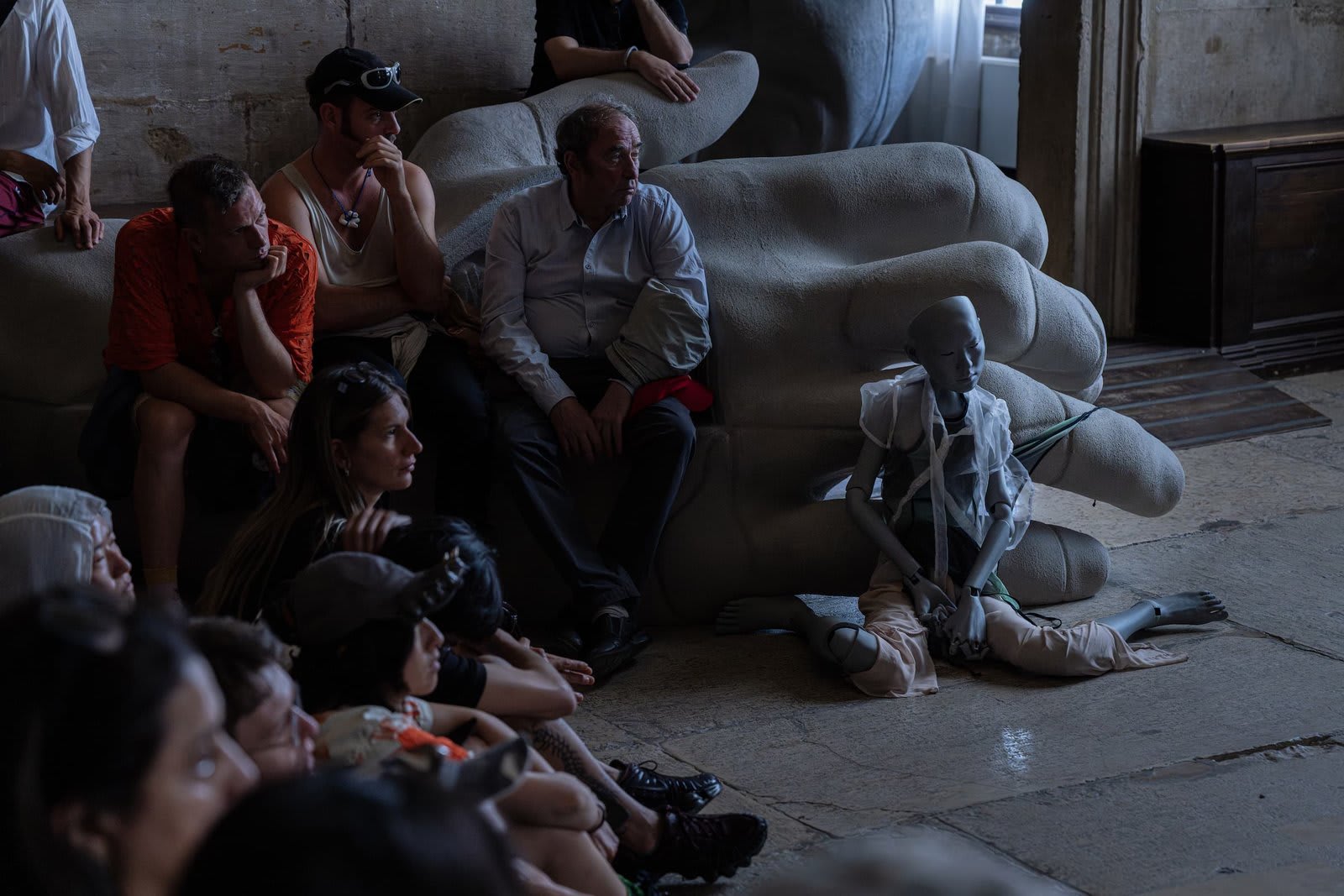
Eunju Hong, She seemed devastated, when I was weeping with joy, 2026. Performed alongside Li Yi-Fan’s Screen Melancholy, 2026, at Palazzo delle Prigioni, Venice, as part of the 61st Venice Biennale. Courtesy of Taipei Fine Arts Museum. Photo © Lin Guan-Ming
As these layered images collapse, a hollow animatronic head exposes its skeletal interior while the film suddenly seems to spill into the gallery itself. Hidden among the audience, performer Isu Kim Lee emerges as another puppet, a pale double, in this sequence, clad in loose gray workwear and tabi shoes, crawling across the floor toward the life-size humanoid sitting in front of the audience. The figure has a smooth, pale shell, a blank face and articulated joints, its androgynous body dressed in the same muted palette as Kim Lee.
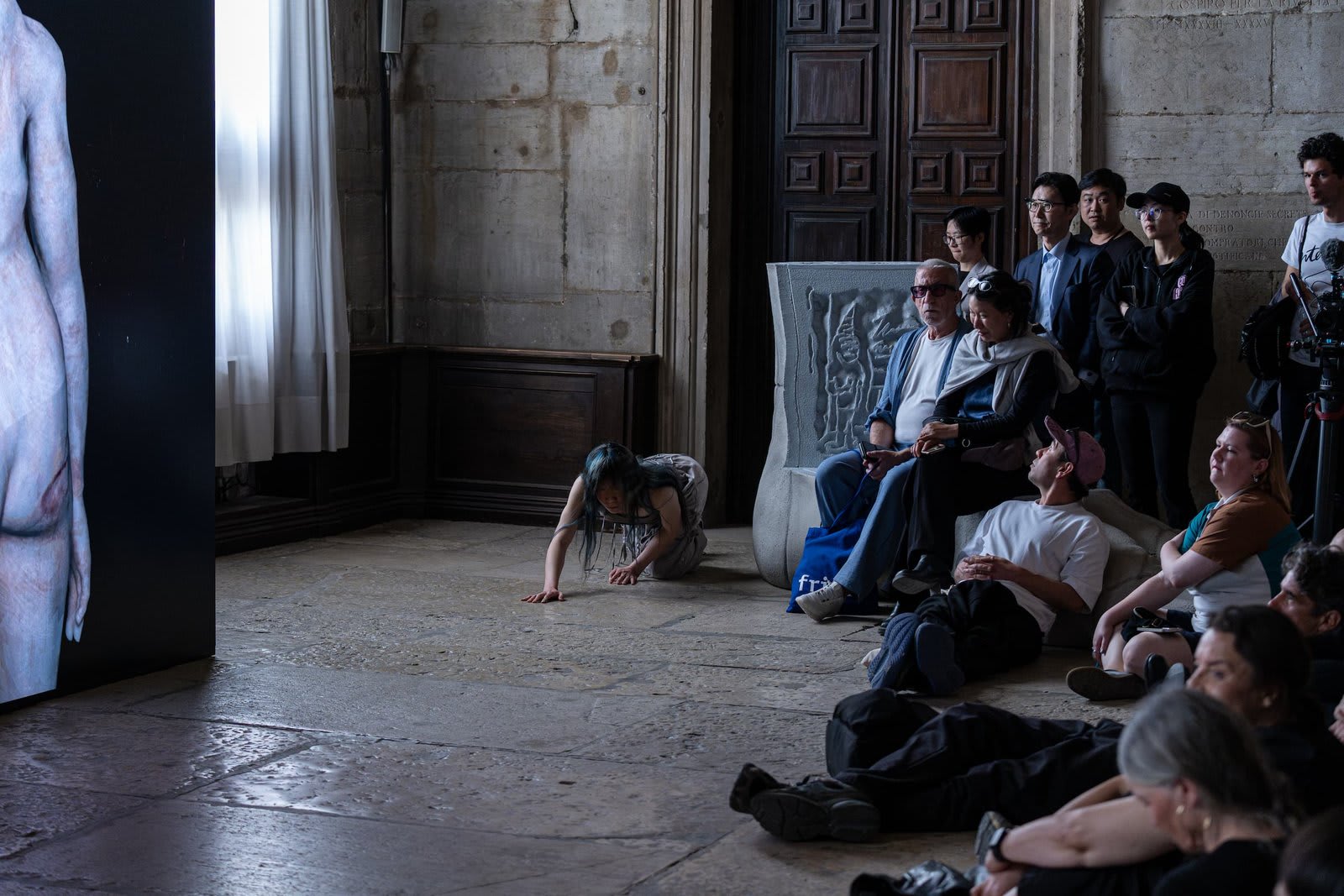
Eunju Hong, She seemed devastated, when I was weeping with joy, 2026. Performed alongside Li Yi-Fan’s Screen Melancholy, 2026, at Palazzo delle Prigioni, Venice, as part of the 61st Venice Biennale. Courtesy of Taipei Fine Arts Museum. Photo © Lin Guan-Ming
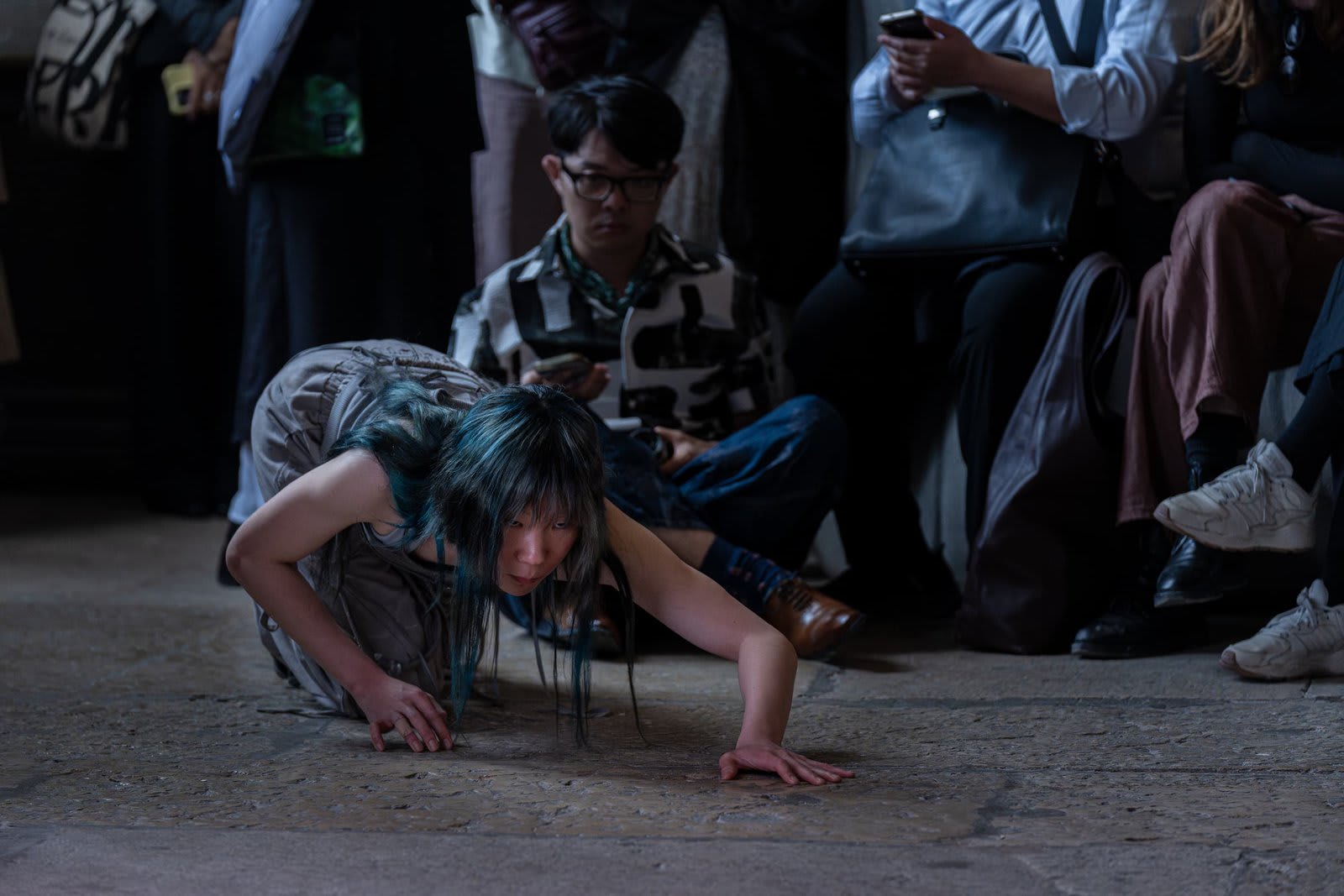
This encounter unfolded during the opening of Taiwan’s presentation at the Venice Biennale, where artist Li Yi-Fan’s signature form of digital puppeteering explored the politics of AI-generated images through a deadpan, bodily comedy that turns questions of agency, sovereignty, and nationhood into an absurd lesson in how images work. Invited by Li to respond to the project, Korean artist Eunju Hong translated the film’s recursive logic into bodily terms through an accompanying performance. Together, the two works are animated by similarly uncanny figures, hovering between flesh and fabrication, person and puppet, asking where control ends and agency begins.
Beginning a sequence of intimate encounters with the pale, 3D-printed figure, Kim Lee first met the inert dummy close to the ground, folding their body around its rigid limbs. Kim Lee clasped the doll’s hands while hooking arms around its torso, before rolling and twisting around on the ground, alternately carrying its weight and allowing the figure to pull them off balance.
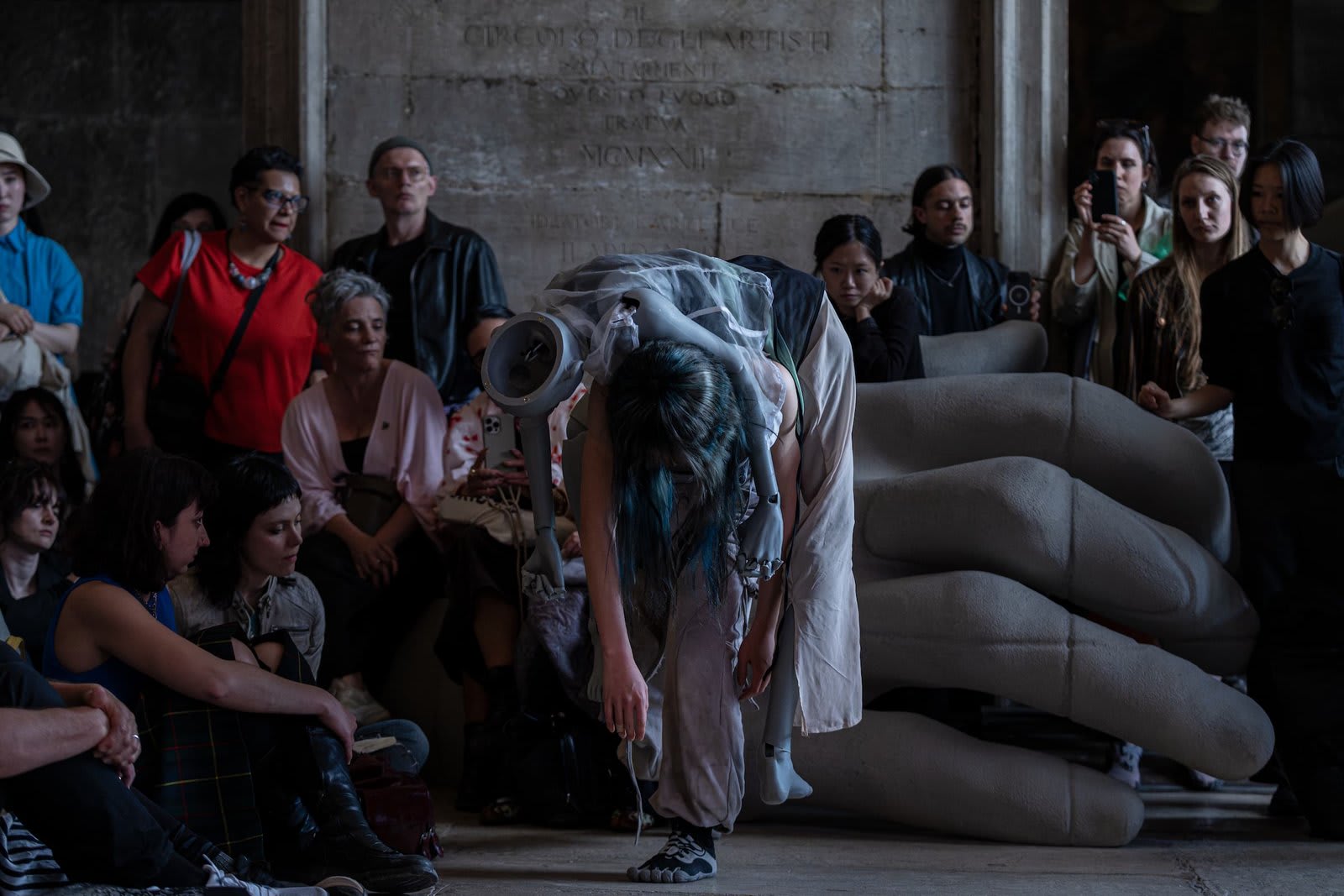
Eunju Hong, She seemed devastated, when I was weeping with joy, 2026. Performed alongside Li Yi-Fan’s Screen Melancholy, 2026, at Palazzo delle Prigioni, Venice, as part of the 61st Venice Biennale. Courtesy of Taipei Fine Arts Museum. Photo © Lin Guan-Ming
Later, the figure was suspended from a camera-support rig strapped to Kim Lee’s body. As the performer walked, turned, and spun throughout the space, the puppet swung along—sometimes facing them like a dance partner, sometimes dangling or pitching away before being drawn back. At times, the surrogate lay limp across the performer; in other moments, its stiff limbs seemed to extend Kim Lee’s own gestures, making it difficult to tell which body was directing which.
If one recognized in Li’s film the virtual loop architectures of The Matrix (1999) or Inception (2010), then Hong’s humanoid likewise would have brought to mind the cyborgs of director Mamoru Oshii’s Ghost in the Shell 2: Innocence (2004), a landmark of Asian techno-futurism. Those artificial bodies were shaped by Japanese Bunraku puppetry, the imprint of which Hong’s figure also seemed to carry. Yet this shared lineage is more than visual. Bunraku’s near-life-sized figures are animated by visible puppeteers, their mechanical movements held in tension with the human bodies that produce them.
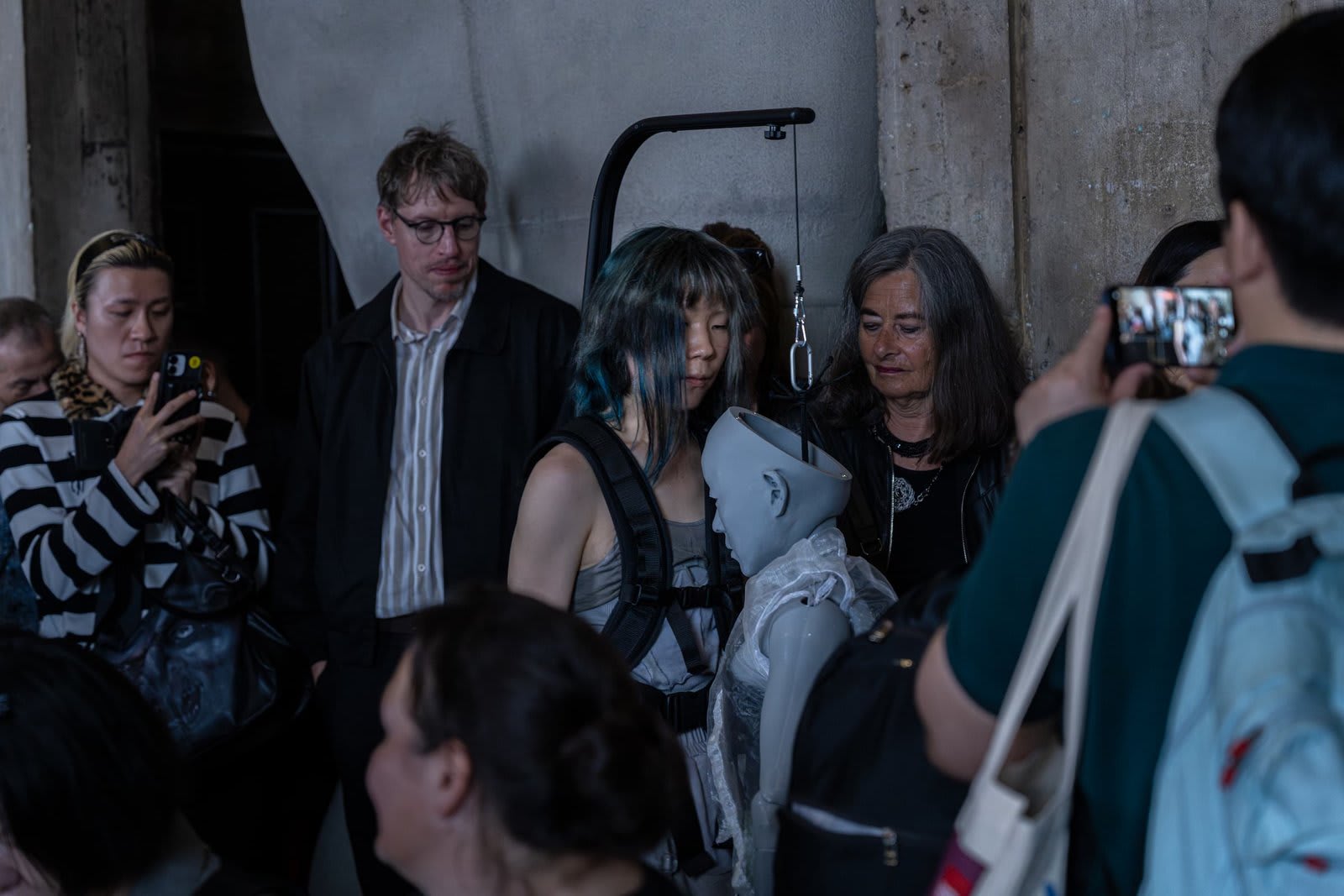
Eunju Hong, She seemed devastated, when I was weeping with joy, 2026. Performed alongside Li Yi-Fan’s Screen Melancholy, 2026, at Palazzo delle Prigioni, Venice, as part of the 61st Venice Biennale. Courtesy of Taipei Fine Arts Museum. Photo © Lin Guan-Ming
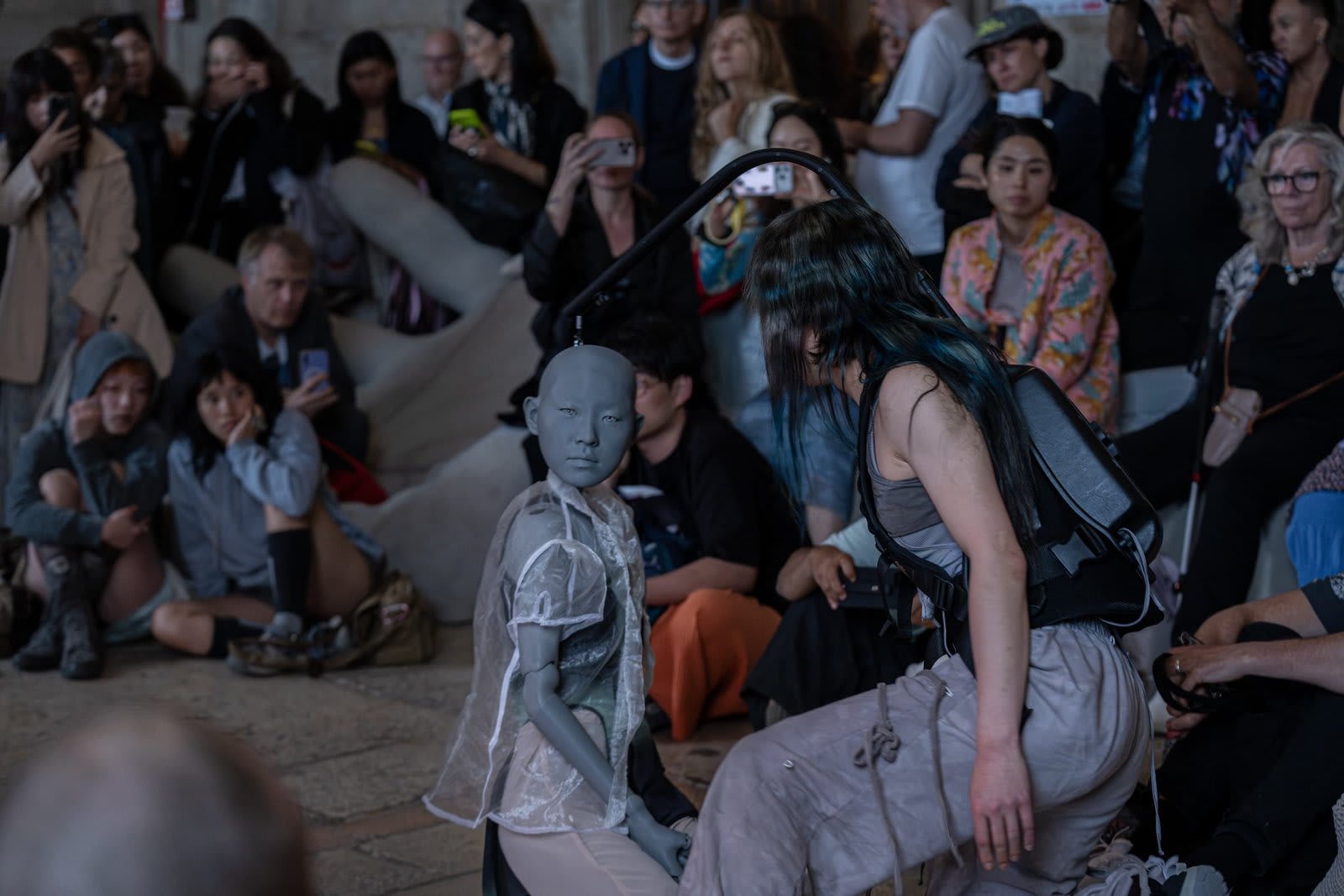
For Hong, this lineage also carries a specific historical charge. She traces the project back to her research on the traditions of Korean puppetry that were disrupted during the era of Japanese colonial rule (1910–45). These practices were systematically suppressed, leaving only scattered traces: a handful of regional troupes, isolated village performances, and sparse records. In the efforts today to revive these oppressed cultural practices, what survives is less a continuous custom than a reconstruction assembled from these remains.
This historical dimension is articulated explicitly in Hong’s Shadow Play (2025), a two-channel documentary previously exhibited alongside this same performance. The film moves between field recordings in Korea and Japan and a Bunraku mask-maker’s workshop, colonial ethnographic photographs, and historical records of performances.
The two channels move from present-day fieldwork to fragments of history. Masks and costumes recorded in a 1493 treatise known as Akhak Gwebeom are followed by Mimaji, a historical Korean performer from the Bakjae kingdom said to have brought the mask dance to Japan in the seventh century (an episode often cited in competing accounts of how the Japanese practice of Noh developed), and by the Ogwangdae dances carried on discreetly by Korean elders under colonial rule before a public revival in the 1960s. These historical facts changed how I read the ending scene of the performance in Venice—and, ultimately, what I thought of the piece as a whole. Throughout, the humanoid seemed to exert an increasing pull over Kim Lee, drawing the performer into an uneasy duet. Toward the end, the performer swept the 3D-printed body up in a bridal carry, seeming to signal the finale, when Hong herself suddenly rushed in, wrestled the puppet from Kim Lee and claimed it as her own. Cradling the humanoid body now in her arms, Hong buried her face into its chest and began to weep.
The intimate gesture might initially have been read through the logic of the uncanny valley, as an unsettling attachment to a body suspended between person and machine. But in light of Hong’s historical research, the tears suggested something even stranger. They reversed the logic of Shadow Play: If it was a performer from Baekje who, in fact, brought masked dance to Japan way back when, then Japan’s long history of masked and artificial bodies can, in turn, be read as a route back towards Korea’s colonially suppressed past. Hong’s crying over the Bunraku-adjacent humanoid—or rather, the Korean mask within it—becomes a kind of reverse hallucination, giving form to what survives only as a trace.
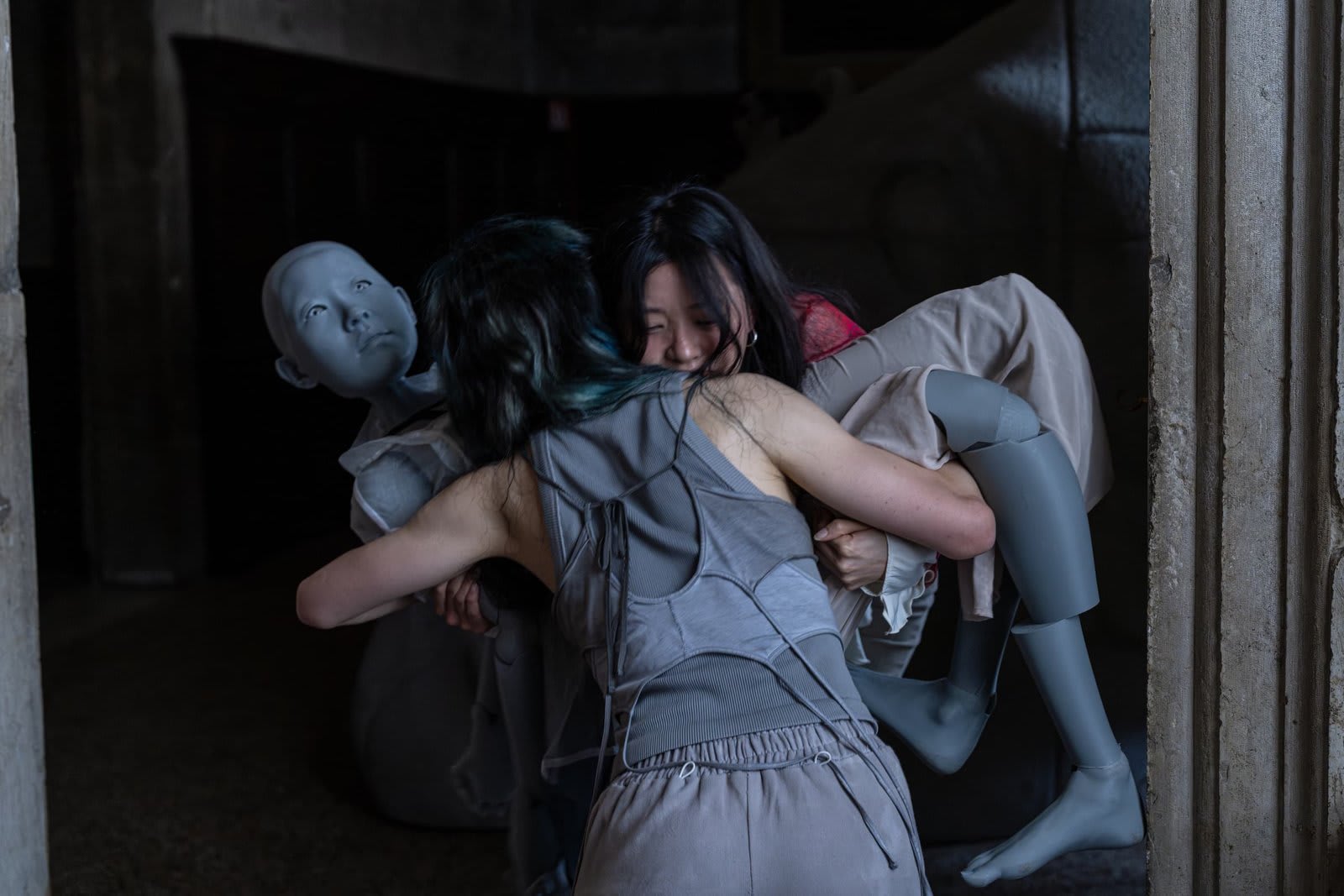
Eunju Hong, She seemed devastated, when I was weeping with joy, 2026. Performed alongside Li Yi-Fan’s Screen Melancholy, 2026, at Palazzo delle Prigioni, Venice, as part of the 61st Venice Biennale. Courtesy of Taipei Fine Arts Museum. Photo © Lin Guan-Ming
Bunraku is recast as a vessel for what colonial history left discontinuous while simultaneously destabilizing the hierarchy between master and surrogate. The figure that Hong holds, then, can be read not as a cyborg that has returned to haunt its human master but as a historical revenant arriving through the prehistory of Japanese techno-futurism. Her embrace is an unexpected act of ownership: Through mourning, she lays claim to the colonial rupture that rendered its recovery impossible.
주인의 도구로 복화술하기
퍼포먼스명: 내가 환희에 젖어있을 때 그녀는 절망에 차 있었다
홍은주
팔라초 델레 프리조니, 베니스
관객들은 프리스탠딩 스크린 주위에 반원형으로 모여 앉아 절정으로 치닫는 영상을 지켜본다. 디지털 인형이 우리가 앉아있는 이 베니스 전시관의 렌더링 속을 지나간다. 이내 그 렌더링 안에 똑같은 전시관이 좀 더 작은 크기로 들어있는 모습이 드러난다. 두 번째 인형이 화면 안으로 걸어 들어와 작은 꼭두각시를 집어들고, 그의 입을 빌려 점점 더 실존적 질문들을 던진다. 자의식이 이 미장아빔에서 빠져나갈 출구라도 되는 듯이. 그러나 화면은 다시 한번 안으로 접혀 들어가며, 마트료시카 인형처럼 포개진 또 한 겹의 전시관을 드러낼 뿐이다.
겹겹의 이미지가 무너지며 속이 텅 빈 애니매트로닉 두상의 내골격이 드러날 때, 영상은 갑자기 화면 밖 전시관으로 흘러넘치는 듯하다. 관객들 사이에 숨어 있던 또 하나의 꼭두각시, 공연자 김이이수가 모습을 드러낸다. 헐렁한 회색 작업복에 발가락이 갈라진 신발 차림의 창백한 분신은 전시장 바닥을 기어 관객들 앞에 앉아 있는 실물 크기의 인간 인형에게로 다가간다. 인형은 매끄럽고 창백한 외피와 표정 없는 얼굴에 구체 관절을 지녔고, 중성적인 몸에는 김이이수와 같은 빛바랜 회색 옷을 걸쳤다.
이 만남은 베니스 비엔날레 대만관 병행전시 오프닝에서 펼쳐졌다. 대만관의 작가 리이판은 특유의 디지털 인형극 형식으로 AI 생성 이미지의 정치학을 탐구한다. 작가는 신체를 활용한 무표정의 코미디를 통해 주체성, 주권, 국가에 관한 질문을 이미지의 작동 원리에 관한 부조리한 수업으로 바꿔놓는다. 한국 작가 홍은주는 그의 초청으로 이 작품에 응답하여 영상의 자기순환적 논리를 신체 언어로 번역하는 퍼포먼스를 함께 선보였다. 비슷하게 기이한 인형 형상들이 이끌어가는 두 작품은 모두 살과 인공물, 사람과 꼭두각시 사이를 서성이며, 통제가 끝나고 주체성이 시작되는 경계를 묻는다.
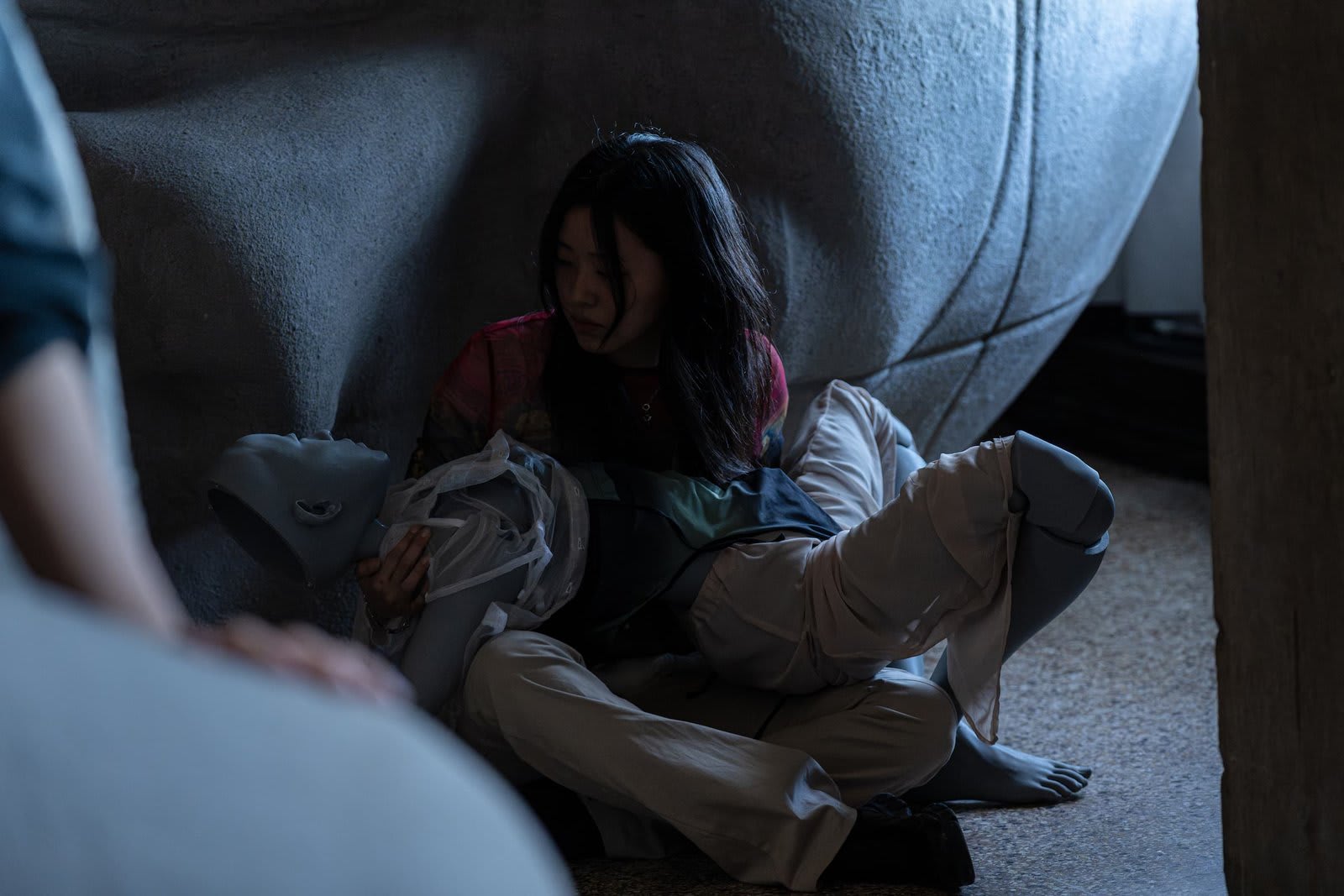
Eunju Hong, She seemed devastated, when I was weeping with joy, 2026. Performed alongside Li Yi-Fan’s Screen Melancholy, 2026, at Palazzo delle Prigioni, Venice, as part of the 61st Venice Biennale. Courtesy of Taipei Fine Arts Museum. Photo © Lin Guan-Ming
김이이수는 창백한 3D 프린트 인형에 점차 친밀하게 맞닿기 시작한다. 처음에는 바닥에 웅크려, 미동도 없이 앉아 있는 인형을 마주하고, 다음으로 뻣뻣한 팔다리에 자신의 몸을 감는다. 인형과 손을 맞잡고 팔로는 상체를 감싸안은 다음 바닥을 구르고 몸을 뒤튼다. 인형의 무게를 떠안았다가, 이내 인형이 자신을 끌어당겨 중심을 잃도록 내맡긴다.
후반부에 이르면 인형은 김이이수가 착용한 카메라 거치대에 매달린다. 공연자가 전시장을 걷고, 방향을 틀고, 빙글빙글 도는 동안 인형도 이리저리 흔들린다. 댄스 파트너처럼 공연자를 마주 보기도 하고, 대롱거리거나 멀리 튕겨 나갔다가 다시 끌려오기도 한다. 이 대리자는 어느 장면에서는 공연자의 몸 위에 축 늘어졌다가, 또 다른 장면에서는 그 뻣뻣한 팔다리로 김이이수의 몸짓을 연장하는 듯 보여서, 어느 몸이 어느 몸을 이끄는지 가려내기 어렵다.
리이판의 영상이 〈매트릭스〉(1999)나 〈인셉션〉(2010)의 순환적 가상 구조를 연상시킨다면, 홍은주의 인간 인형은 아시아 테크노퓨처리즘의 기념비적 작품인 오시이 마모루의 〈공각기동대 2: 이노센스〉(2004)의 사이보그를 떠올리게 한다. 영화 속 인공 신체의 모습은 일본 분라쿠 인형극의 영향을 받았고, 그 흔적은 홍은주의 인형에도 남아 있는 듯 보인다. 이 공통의 계보는 시각적 층위에 머무르지 않는다. 관객 앞에 모습을 드러낸 인형사들이 사람에 가까운 크기의 분라쿠 인형을 조종할 때, 인형의 기계적인 움직임은 그 동작을 만들어내는 인간의 몸과 팽팽한 긴장을 이룬다.
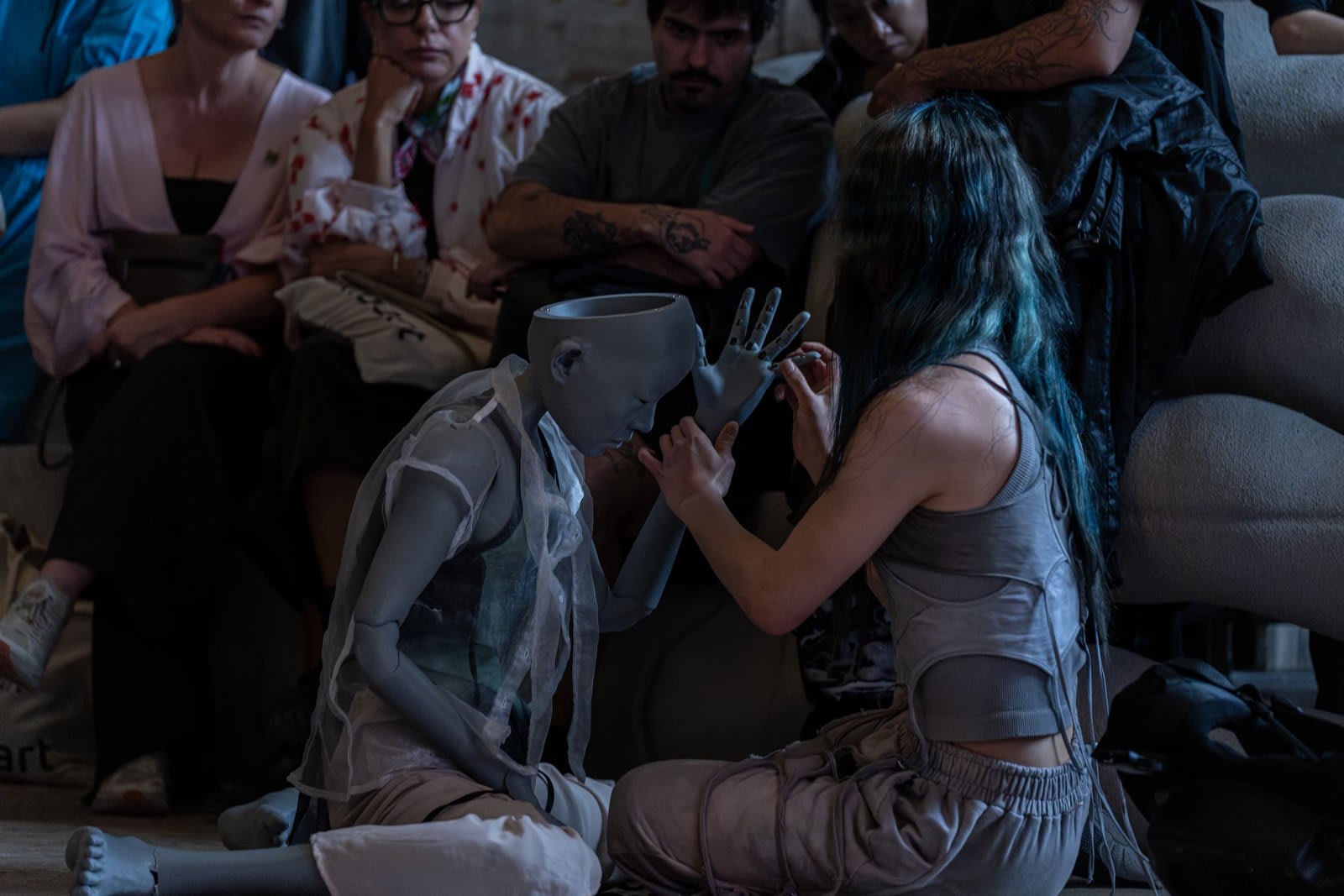
Eunju Hong, She seemed devastated, when I was weeping with joy, 2026. Performed alongside Li Yi-Fan’s Screen Melancholy, 2026, at Palazzo delle Prigioni, Venice, as part of the 61st Venice Biennale. Courtesy of Taipei Fine Arts Museum. Photo © Lin Guan-Ming
이 계보는 홍은주에게 특수한 역사적 함의를 지닌다. 작가는 이 작품이 일제강점기(1910~45년)에 명맥이 끊긴 한국 인형극 전통에 대한 리서치에서 출발했다고 말한다. 체계적인 억압 끝에 한국 인형극은 소수의 지역 극단, 드물게 남은 마을 민속극, 희소한 기록 같은 산발적인 흔적으로만 남게 되었다. 탄압받은 이 문화적 실천을 되살리려는 오늘날의 노력 속에서도, 살아남은 것은 이어져 내려온 관습이 아니라 남겨진 파편들을 재조립한 복원물에 가깝다.
홍은주는 2채널 다큐멘터리 〈Shadow Play〉(2025)에서 이러한 역사적 측면을 명시적으로 다루었다. 이전에 퍼포먼스와 함께 상영된 이 작품은 한국과 일본에서의 현장 촬영 영상, 분라쿠 가면 제작자의 공방, 식민지 시기 민족지 사진, 공연 사료 사이를 오간다.
두 채널의 영상은 오늘날의 현장 조사에서 역사의 파편들로 옮겨간다. 1493년 편찬된 《악학궤범》에 기록된 탈과 의복에 이어 7세기 일본에 가면극을 전했다고 알려진 백제의 무용가 미마지가 등장한다(이 일화는 일본 노(能)의 기원을 둘러싼 엇갈린 설명들에서 자주 언급된다). 식민지 시기 원로들이 남몰래 이어오다 1960년대 다시 대중적으로 부활한 오광대놀이가 뒤를 잇는다. 일련의 역사적 사실은 필자가 베니스에서 본 퍼포먼스의 마지막 장면을 독해하는 방식을, 나아가 작품 전체에 관한 생각을 바꾸어 놓았다. 퍼포먼스 내내 인간 인형은 김이이수를 점점 더 강하게 끌어당겨 불안한 듀엣으로 빠져들게 하는 것처럼 보인다. 막바지에 이르러 공연자가 3D 프린트 인형을 품에 안아 올리며 퍼포먼스의 결말을 알리는 듯한 그때, 홍은주가 갑자기 전시장으로 뛰어 들어온다. 그는 김이이수와 몸싸움을 벌여 인형을 빼앗고 자기 것으로 삼는다. 이제 인형을 품에 꼭 안고, 그 가슴에 자기 얼굴을 묻고 흐느끼기 시작한다.
이 내밀한 몸짓은, 처음에는 불쾌한 골짜기의 논리, 즉 인간과 기계 사이에서 유예된 몸을 향한 섬뜩한 애착으로 읽혔을지 모른다. 하지만 홍은주의 역사적 리서치를 떠올려보면 그 눈물은 더 기이한 무언가를 암시한다. 눈물은 〈Shadow Play〉의 논리를 뒤집는다. 먼 옛날, 일본에 가면극을 전한 사람이 실은 백제의 무용가였다면, 역으로 일본 가면극과 인공 신체의 긴 역사는 식민 지배로 억압받았던 한국의 과거로 귀환하는 하나의 경로로 읽을 수 있다. 홍은주가 분라쿠 인형을 닮은 인간 인형, 아니, 사실은 그 안에 깃들어 있는 한국의 탈을 붙들고 우는 울음은, 일종의 뒤집힌 환각이 되어 흔적으로만 남은 것에 형체를 부여한다.
분라쿠는 식민의 역사가 단절시킨 것을 담아내는 그릇으로 재구성되는 동시에, 주인과 대리자 사이의 위계를 뒤흔든다. 그렇다면 홍은주가 안아 든 인형은 인간 주인을 위협하기 위해 돌아온 사이보그가 아니라, 일본 테크노퓨처리즘의 전사(前史)를 거쳐 도착한 역사의 유령으로 읽힐 수 있다. 그가 인형을 껴안는 것은 예상치 못한 소유의 행위이다. 그는 애도를 통해 그 이전으로의 회복을 불가능하게 만든 식민주의의 파열을 자기 것으로 삼는다.
글: 지안 첸
번역: 박세진