
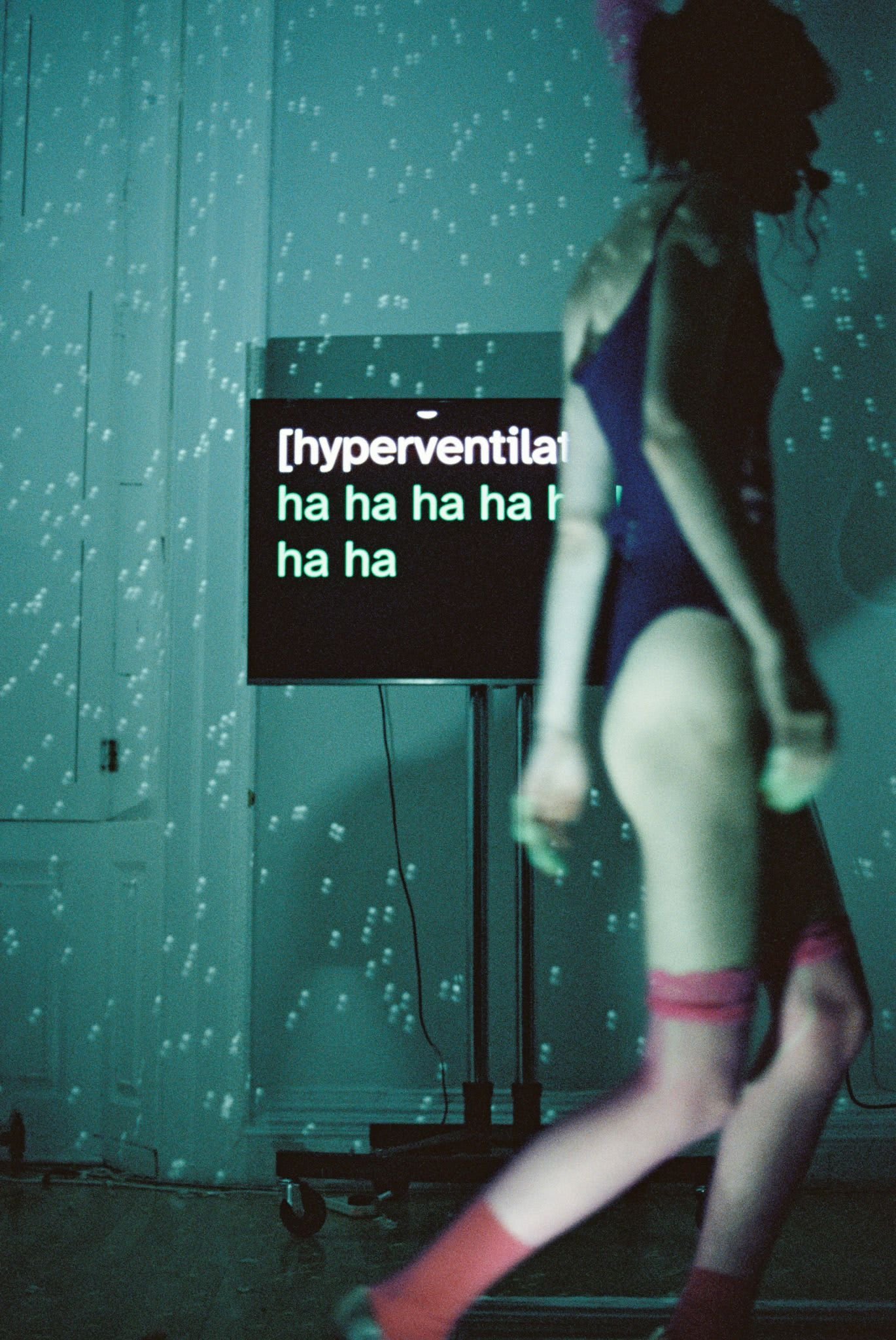
On tonight’s show, girls are telling it like it is. A scripted dialogue rolls down the LCD TV at the back of the room facing the chairs gathered for the audience at the Institute of Contemporary Art, London. Biogal reads this line and those that follow into her headset mic like it’s a conference karaoke and these are the words to her song. As she attempts to keep chorus, the artist runs through a series of actions, tied together not so much by an advancing plot as by the insistent tempo of the constantly scrolling teleprompter and the attendant expectation of failure that provides I Feel Very Attacked!’s baseline emotional thrum. Among other things, Biogal directs a small lamp at a hanging disco ball; closes the room’s wooden shutters; cuts open an onion and places the halves beneath her eyes to force tears; writes on and then shatters a reclaimed window placed on the gallery floor, with lipstick and heels; mounts a ladder (kicking off these same stilettos) to attach strips of paper to the built-in air-conditioning unit; before, finally, lubing up the propeller of the remote control helicopter she asked the curator to pilot earlier in the performance, then pushing it into her anus.
I Feel Very Attacked!
Part of PULSE at ICA, London
Review

All photos: Biogal, I Feel Very Attacked, 2025. Performed at the Institute of Contemporary Arts, London. Photo by Jean Cleverley
This last provocation—in some ways the ultimate and, if not expected, at least predictably climactic consummation—throws into strong relief the magnetic combination of vulnerability and agency that provide the performance’s more minor moments of tension. Minor in scale perhaps, but also minor in key: the knife, the ladder, the broken shards of glass (on which Biogal did indeed cut herself, staining the pine floor in the final act, the origin of the blood ambiguous), all picked up despite their potential to do harm to the performer in such a way as to prematurely end or alter the evening’s trajectory. Even her entrance—a blindfolded procession up the aisle between the chairs in an ivory off-the-shoulder gown—could have ended in tears, as she visibly stumbled against the raised lip of the loose window frame lying sideways in front of the television. The bride strips herself bare, even, before these two (not so large) panes of glass. No waiting bachelor, no father of the bride to give her away (although Biogal’s parents were in fact both in the audience), the artist commits herself to this artistic institution that, like that of marriage, might promise a girl limited facilitation of a fantasy in part her own and in part her culture’s.
The upstairs room at the ICA where this performance took place is no stranger to a wedding. Previously part of the space available for exhibitions (and still quaintly called the “Upper Galleries”), this space is now hired out by the institute for private events or used for public “talks and engagement,” which was indeed the programming context for I Feel. A “site-responsive performance” in the parlance of the press release, I Feel makes use not just of the architectural constraints and accoutrements included in the limited offer of technical support (an offer that bizarrely included the gigantic disco ball mounted on a stand in the corner), but Biogal’s marginal position within the institution from which these offers flow. Or, more properly, fail to flow: It feels almost redundant to note the old game by which trans artists are attached to auxiliary programs centered around their cis contemporaries, who are afforded more handsome compensation.
Cisness becomes another material in I Feel, analogous to the grand Regency architecture of the ICA’s location before Buckingham Palace on the Mall or the props and tech borrowed from friends. Or, falling somewhere between the two: sex being both an unimpeachable nineteenth-century structure and the product of our intimate relations. In I Feel both limited systems are equally up for grabs, a realization of the performer’s (or sexed subject’s) agency to actively engage with the variegated facets of a primary material of subjectivity—to enter its logics, make a mess, and try to survive the consequences. Biogal exposes the seemingly self-evident logics of sex and the art institution as an aesthetic of bareness that requires its own artful response. Returning to the on-screen dialogue that forms the performance’s only constant action, it becomes apparent it’s been cribbed from clips of the behind-the-scenes reality show Ru Paul’s Drag Race: Untucked. The drama revolves around the responses of the judges and fellow queens to Laganja Estranja, a contestant on the franchise’s sixth season much mocked for her outré use of gay slang and general “phoneyness.” There is a violent irony in a bunch of “men in wigs” (to use season winner Bianca del Rio’s phrase) questioning the realness of a queen who would later come out as a trans woman. On the other hand, I Feel resists making Estranja into a cipher for the transfeminine experience at large; rather, the show’s transcript speaks more to the performance of femininity and its transgression exhorted by Biogal in this and other arts spaces. Reading aloud, inviting us to read with her (even asking an audience member when she was unable to continue), she takes this document seriously as an archive of trans experience.

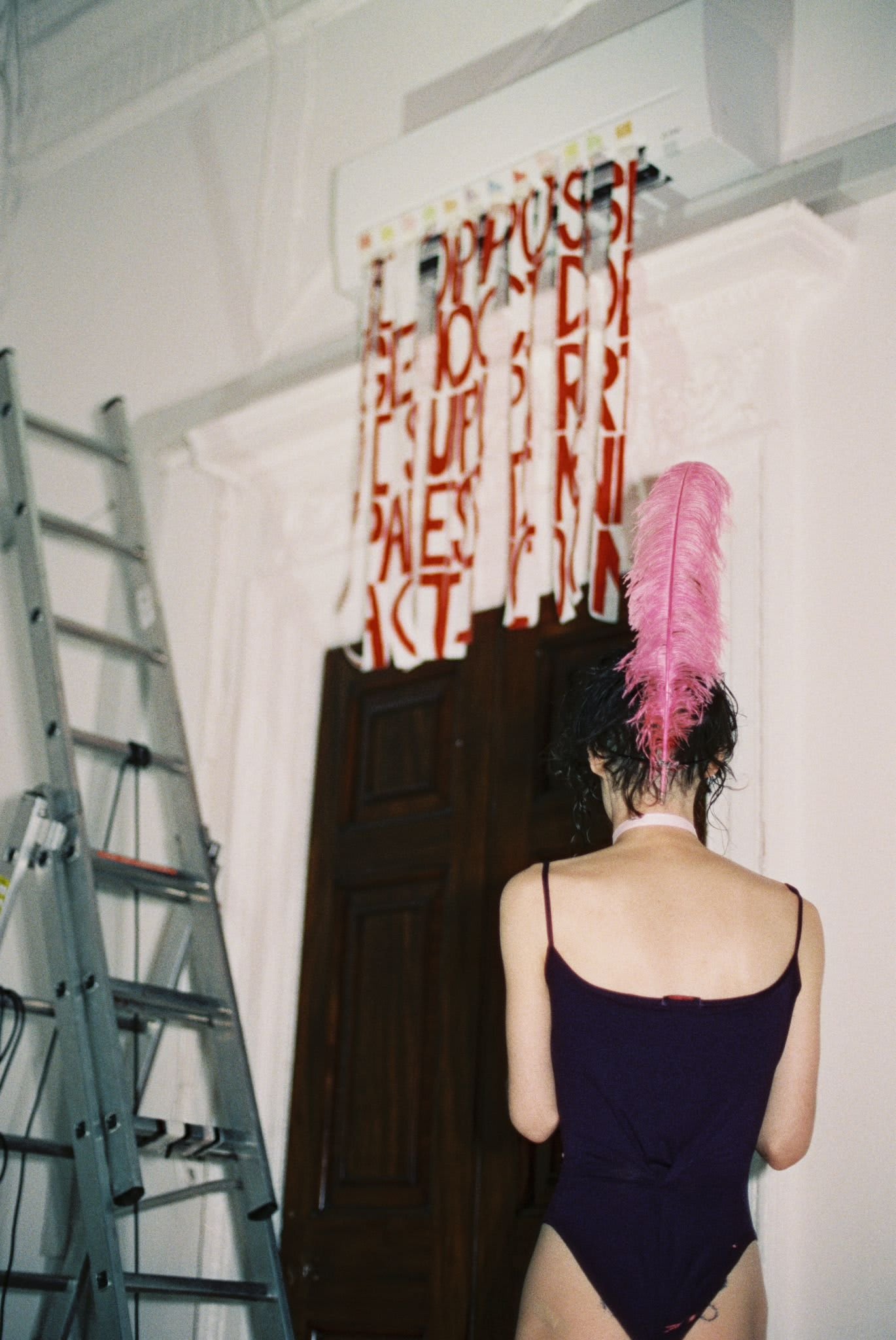
And yet, it is also I Feel’s central farce. As well as raising the tension, the impossible task of continuous reading is darkly comic; not to mention that a Drag Race reference is too on the nose, too obvious particularly when performed as a kind of inverse lip-synch. The voiced dialogue is a smokescreen for more silent political utterances: a riff on the transphobic catchphrase “adult human female” written across the front of Biogal’s bodysuit; “the fourth Overton ceiling” lipsticked on the to-be-smashed window; and a placard in support of Palestine Action attached in strips to the air-conditioning unit. Unbeknownst to the ICA, these words of support were under their nose the entire time, a pile of shredded paper on the makeshift stage. When attached to the fan, all the air in the room had to pass through the slogan “I OPPOSE GENOCIDE. I SUPPORT PALESTINE ACTION,” as if all that air was not already in proximity to this statement and its illegality. Every weekend since July 5, 2025, scores of people are arrested for holding signs bearing a similar slogan around the corner in Trafalgar Square or opposite the Houses of Parliament. In tonight’s show Biogal tells it like it is, under the cover of saying what the institution wants to hear. Subterfuge as survival strategy, both on and off the stage.