What does a body—artistic, social, political—have to endure today in order to remain calibrated within its traditions and its futures? If calibration1Calibration refers to the continuous process by which a system—technical or embodied—adjusts its internal relations in response to external pressures. From a phenomenological perspective, calibration describes the temporal sedimentation of bodily habits through which perception and action are continuously recalibrated in relation to the world. When applied to bodies, calibration names the accumulated labor through which technique, memory, and constraint are negotiated over time. is understood less as an act of maintaining stability and more as a continual renegotiation of pressures, then what is the role of the body2Here, “body” is understood as an analytic figure that exceeds the dancer’s body while remaining grounded in it; the dancer appears not as an exception but as a particularly intensified site of embodied negotiation. that must hold these shifting balances: the weight of inherited forms, the frictions of historical memory, the demands of the present and future, the politics of visibility and representation? Is this not a labor in itself, a labor that keeps the body’s physical and emotional axis alive under conditions that continually threaten to pull it apart?
On the Movement of Calibration
Lee Yanghee at Performing Arts Market in Seoul
Review
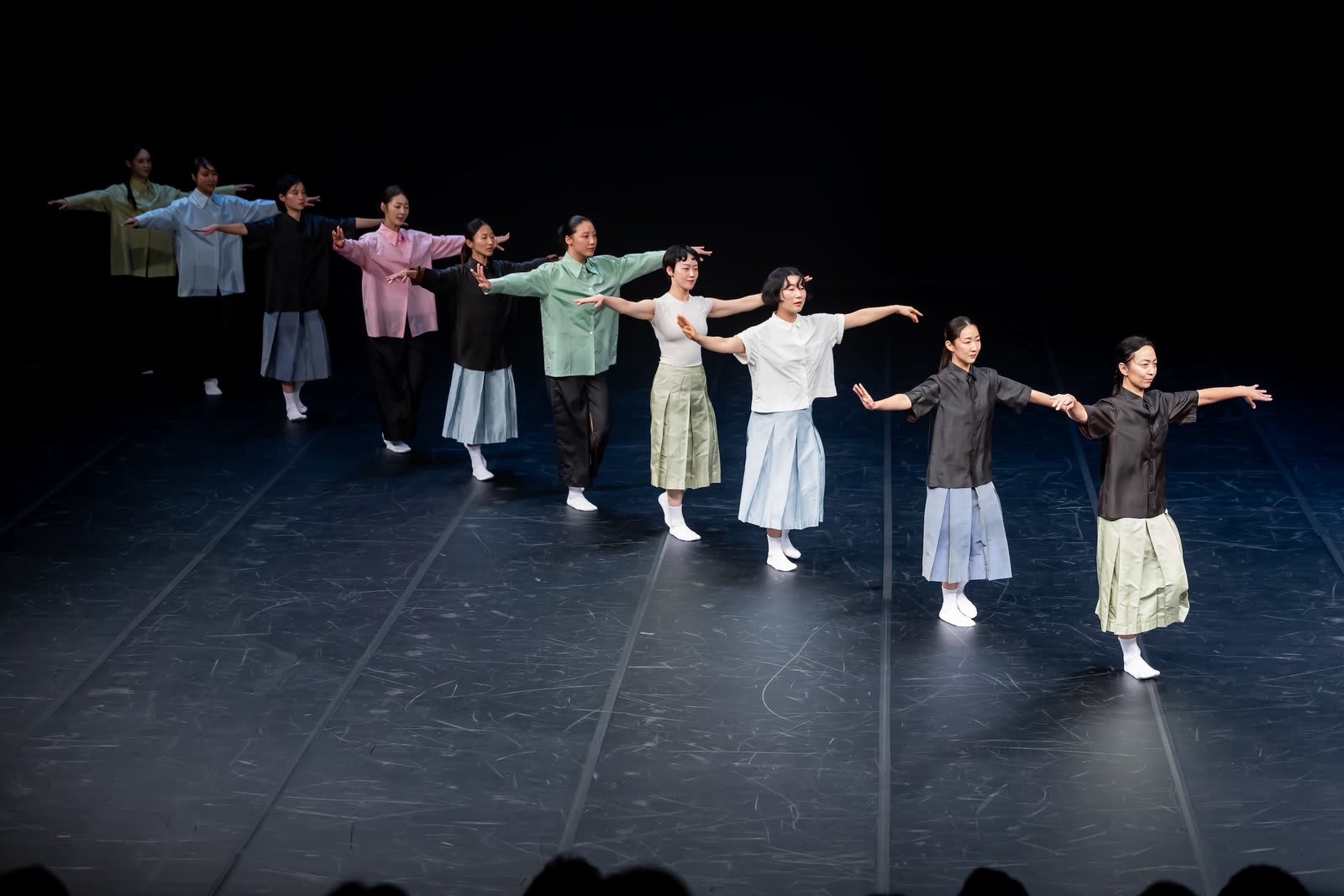
All photos: Lee Yanghee, Shimmering, 2025. Performed at Performing Arts Market in Seoul (PAMS). ⓒ PAMS 2025_KAMS. All rights reserved
On October 15, 2025, on the occasion of the PAMS Choice program at the Performing Arts Market in Seoul, I sat down at the Haneul Round Theater to see Shimmering by choreographer Lee Yanghee. The piece begins long before the stage lights rise. It begins in the years of training sedimented into the ten dancers’ bodies that appear with faces smiling, displaying a state of ease born of long, disciplined conditioning: repetitions, corrections, soreness, the incremental labor through which the body has learned to emit performative presence. “Training a dancer means to invest time and effort to tune the body,” Lee remarked in a previous interview. “The luminous state that a dancer reaches after enduring repetitive and painful training—that, for me, is shimmering.”3“Jeontong-gwa Hyeondae-reul Ieoganeun Peopeomeonseu” (전통과 현대를 이어가는 퍼포먼스) [A performance bridging tradition and the contemporary], Ijeneun Jibang Sidae (이제는 지방시대), posted September 9, 2023, YouTube, 4 min., https://www.youtube.com/watch?v=zHg6fmQ_nOQ. Here, luminosity is not metaphorical. It appears and is felt in the form of physical vibration—ten bodies whose kinetic residue of lived labor leaks out to us, the audience, at the very moment it disappears.
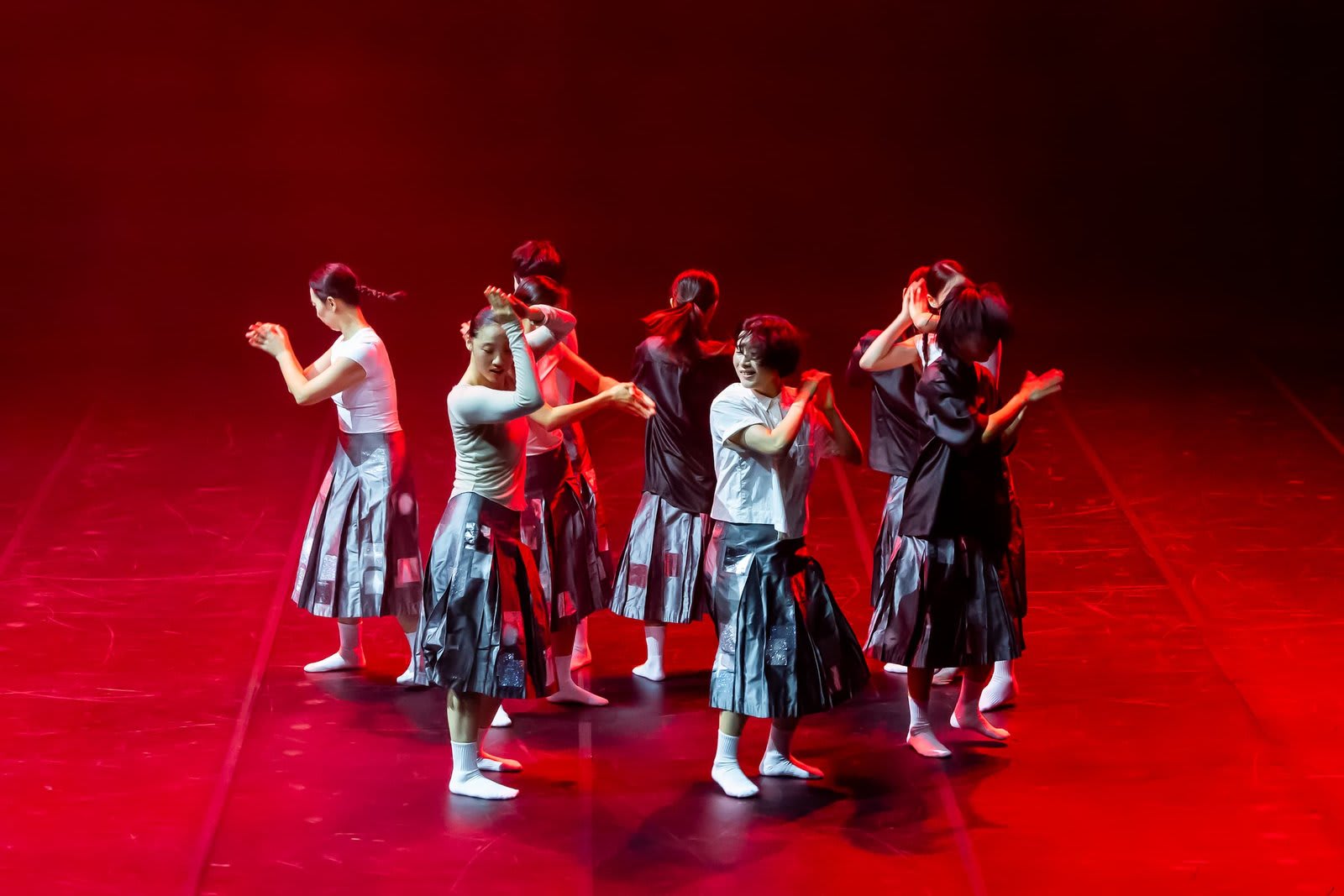
Shimmering is the final work in Lee’s Dance’s Pleasure trilogy, following Gesamtkunstwerk (2019) and Hail (2020).4See Lee Yanghee’s website: https://www.leeyangheestudio.com. Its movement vocabulary draws from traditional Korean dance (shinmuyong) and the aesthetics of 1990s Korean rave culture. Throughout the piece, the performers dance to an upbeat techno pulse under disco lights, entering and exiting the circular stage in various formations—sometimes all ten at once, sometimes in smaller constellations—to perform movements grounded in foundational Korean dance steps such as gibon georeum (the highly stylized basic walking step) or turns characteristic of traditional Korean dance. The dancers oscillate within a tension between citation and embodiment; tradition reveals itself not as a stable repertoire but as a choreography that the dancer’s body wants to test and reconfigure. This tension emerges between what has been learned and what seeks to move otherwise: the lower body and axis remain anchored in a trained Korean dance repertoire, while often the hands and upper body gesture toward a more abrupt, improvisational form similar to what we would witness in club dance.
Alongside this tension there is also pedagogical undercurrent visible throughout the piece. This becomes explicit when, for example, the soundtrack falls away for a few minutes and a recorded female voice enters the space, giving cues in the typical tone of a traditional Korean dance teacher. She speaks the rhythmic syllables of jangdan, improvised patterns that structure the length and texture of each movement. Jangdan function not only as counts but also as embodied mnemonics that guide the student through space. In this moment, the dancers respond and translate the cues through their own trajectories. The audience learns that jangdan functions less as strict notation than as a perceptual framework that guides movement without fixing form. And so hearing this voice in the theater reveals an often unseen dimension of transmission; the lineage of this form lives not only in steps but also in the rhythms and breath-patterns imparted by a teacher. The body is, in this moment, calibrated through the sonic imprint of instruction.
The piece reaches its climax when all ten dancers appear evenly spaced and begin spinning in place for a prolonged duration. The image evokes Sufi whirling, yet here the spin is stripped of devotional rhetoric and instead highlights the exposure of pure technique, making it revealing and unforgiving. The audience senses how difficult it is to maintain axis, tempo, and breath without collapse, and in the context of Lee’s open interrogation of Korean classical dance, the scene becomes doubly charged. It is a test of tradition and a public display of vulnerability, where the limits of training become visible in real time.
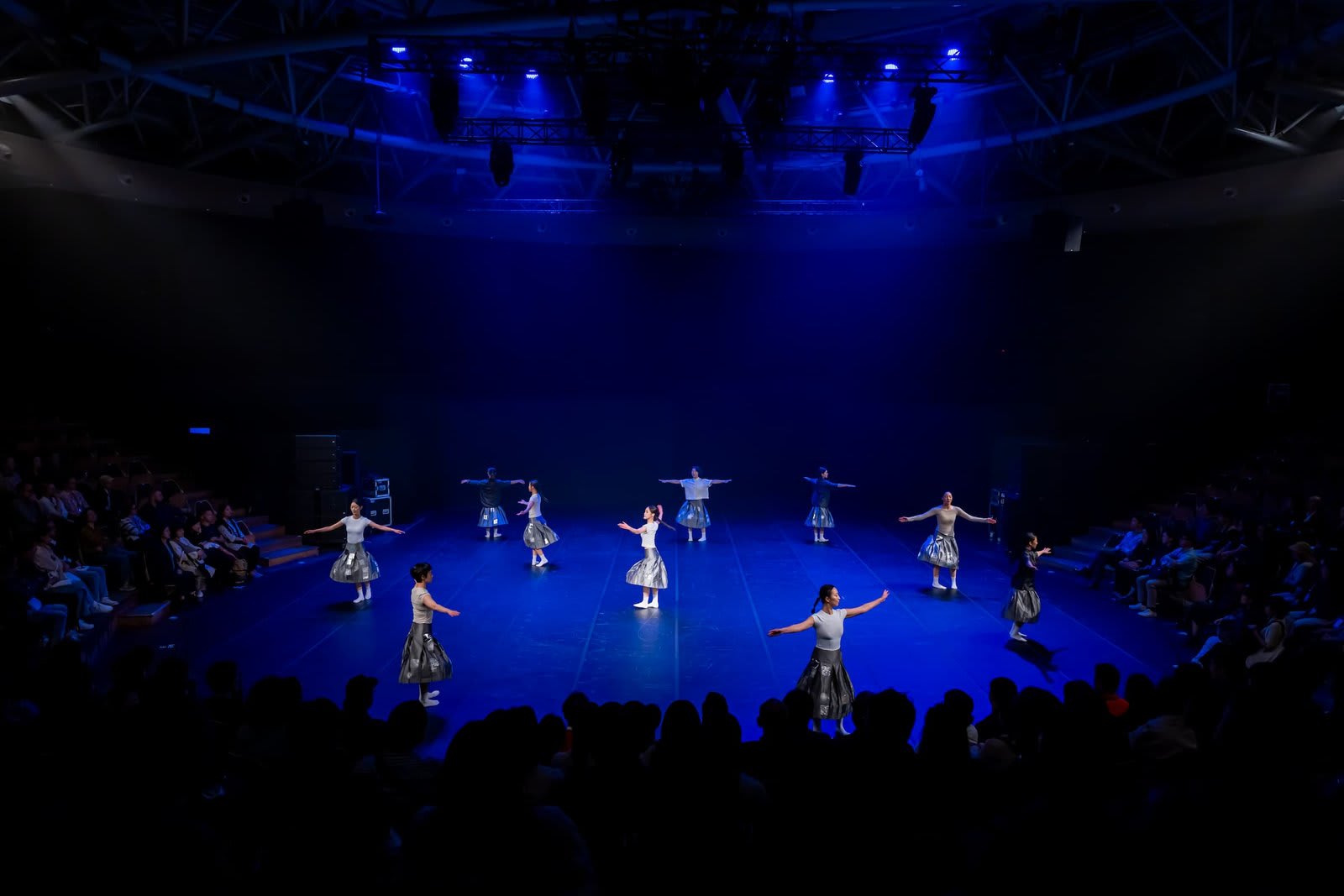
The audience becomes witness to a time filled with continuous micro-adjustments through toes, ankles, knees, pelvis, and ribcage, which render the body’s calibration legible like a choreography of corrections. The sequence feels almost too brutal to watch. It instantly reveals who has internalized timing, who maintains axis, and who carries the longest history of embodied correction. Among the ten performers, Lee’s body—visibly older, steadier, more rhythmically aligned with the techno beat—emerges as the most calibrated. She remains consistent long after the younger dancers begin to compromise shape and axis and slip out of sync with the music. And as the group of ten continues to spin, one observes ten different timelines of training rotating side by side, each body carrying a slightly different lived density of tradition, an archive of discipline, injury, and repair leaking into the space.
Each turn is sedimented labor, micro-transformation, and fatigue memory. If we were to situate this within contemporary art debates around automation, bodily labor, and the politics of preservation, the movement of calibration offers a response to the many artists reexamining the status of craft and disciplined skill as forms of embodied knowledge threatened by digitization. Machine learning systems cannot have exhausted lungs; they do not remember nor choose to carry the asymmetries of a recovered injury or the micro-shakes of long-term practice. The movement of calibration—sometimes painful, sometimes mundane—produces a body that has risked itself repeatedly and refused quick optimization. And only after many years, a time that cannot be accelerated, does it yield this brief shimmering moment in front of a live audience, only to vanish as soon as it appears. It is excess, and none of it is efficient.
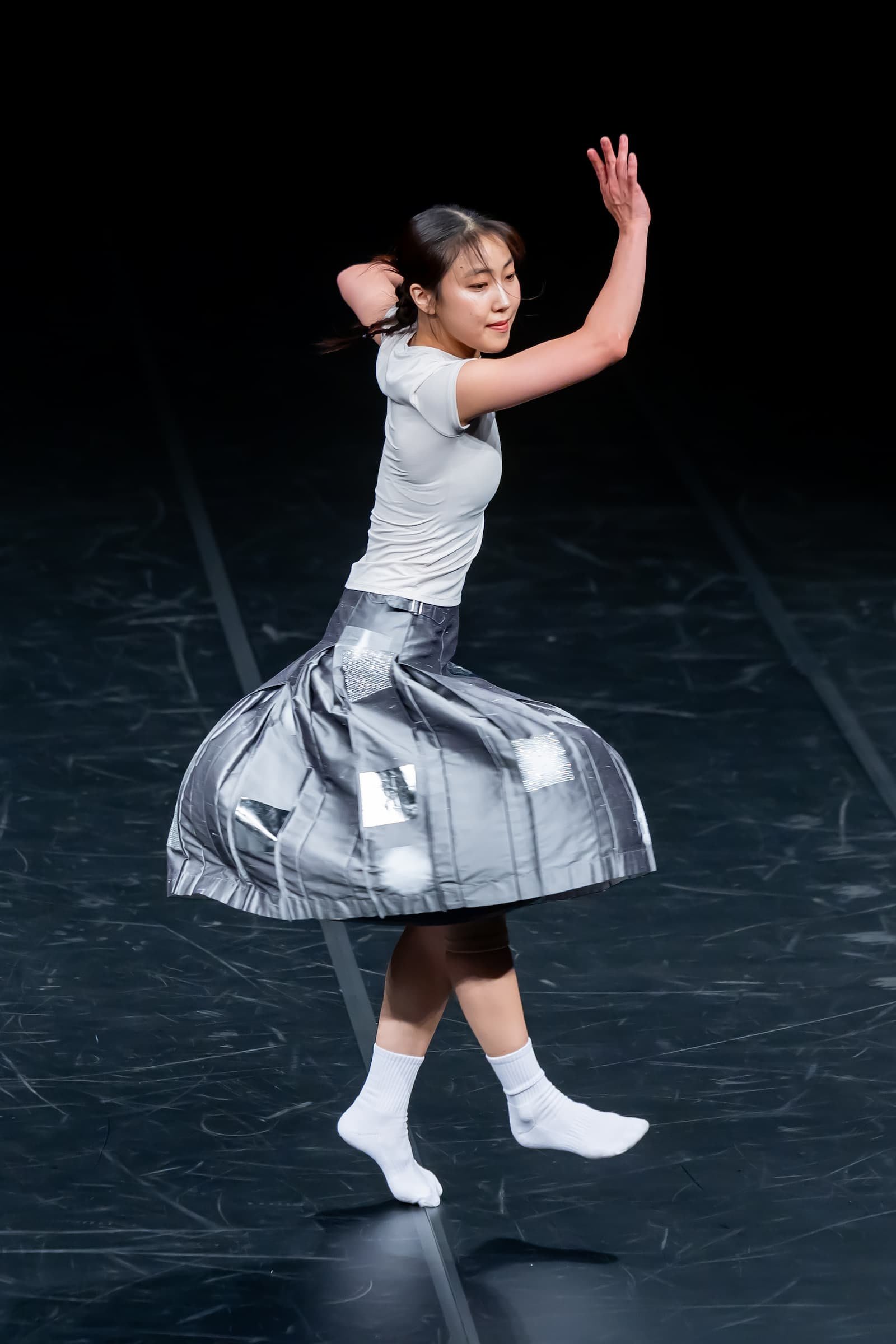
If postmodern choreographers of the 1960s and 1970s—such as Lucinda Childs5See Sally Banes, Terpsichore in Sneakers: Post-Modern Dance (1980; reprint Wesleyan University Press, 2011) and Ramsey Burt, Judson Dance Theater: Performative Traces (Routledge, 2006). and Yvonne Rainer6See Yvonne Rainer, “A Quasi-Survey of Some Minimalist Tendencies in the Quantitatively Minimal Dance Activity Midst the Plethora, or an Analysis of Trio A,” in Minimal Art: A Critical Anthology, ed. Gregory Battcock (1968; reprint Dutton, 1995), 263–73.—produced a structural shift by reorganizing dance at the level of compositional logic and technical value, Shimmering stops short of that threshold. These predecessors’ interventions did not merely restage inherited vocabularies under new atmospheres but redefined what could count as dance structure in the first place: through reduction, task-based movement, repetition, and the refusal of virtuosity as the primary measure of form. Lee’s work, by contrast, leaves the technical grammar of tradition fundamentally intact. Its experimentation unfolds at the level of sensorial framing and stylistic juxtaposition rather than structural redefinition. What results is not a rewriting of the traditional dance grammar, but a sharpened visibility of its constraints and costs.
Shimmering appears to loosen the frame of Korean classical dance by replacing court music with rave-like techno; infusing the upper body with vibrations and shaking reminiscent of club culture; introducing disco-like lighting; and dressing dancers in oversized tops and long skirts that gesture toward modernity. These elements signal a willingness to recompose tradition within contemporary sensorial regimes. Yet the technical core remains rigorously traditional. Footwork, tempo, axis, and lower-body discipline follow established structures with little deviation. Unison dominates. The choreography demands uniform execution regardless of individual differences. The teacher–student distinction becomes visible because precision is not stylistic but infrastructural; it is what allows the tradition to appear at all.
What the work reveals is that calibration is not a fixed state but a continuous movement, an ongoing negotiation between what the body must surrender in order to remain between past and future. The choreography confronts the difficulty of sustaining embodied knowledge within systems that prefer citation over inhabitation, reference over risk. The piece invites admiration but also leaves us with a more unsettled question: What does it cost a body to embody tradition, rather than merely allude to it, in a world increasingly structured around disembodied forms of preservation?
조율의 움직임에 관하여
서울아트마켓에서 만난 이양희
오늘날 몸은—예술적이고 사회적이며 정치적인 몸—은 자신의 전통과 미래 사이에서 조율된 상태를 유지하기 위해 무엇을 감내해야 하는가? 조율(calibration)7여기서 조율(calibration)은 기술적이거나 신체적인 하나의 체계가 외부의 압력에 대응하며 내부의 관계를 지속적으로 조정해 나가는 과정을 의미한다. 현상학적 관점에서 조율은 지각과 행위가 세계와의 관계 속에서 끊임없이 재조정되는 신체적 습관의 시간적 퇴적을 가리킨다. 이를 몸에 적용할 때, 조율은 테크닉과 기억, 제약이 시간 속에서 협상되는 과정에 축적된 노동을 명명한다. 을 안정된 상태를 유지하는 행위라기보다 끊임없이 변화하는 압력 속에서 균형을 지속적으로 재협상하는 과정으로 이해한다면, 이 유동하는 균형을 감당하는 몸8저자가 쓰는 ‘몸’은 무용수의 몸에 기반을 두면서도 그것을 넘어서는 분석적 형상으로 이해된다. 무용수의 몸은 예외적인 존재라기보다 체화된 협상이 특히 응축되어 나타나는 장소로 제시된다. 의 역할은 무엇인가? 전승된 형식의 무게, 역사적 기억의 마찰, 현재와 미래의 요구, 가시성과 재현의 정치학을 짊어진 몸 말이다. 이것 역시 하나의 노동이 아닐까? 끊임없이 몸을 잡아당기고 해체하려는 조건 속에서 신체적 그리고 정서적 축을 살아 있게 붙들어 두는 노동.
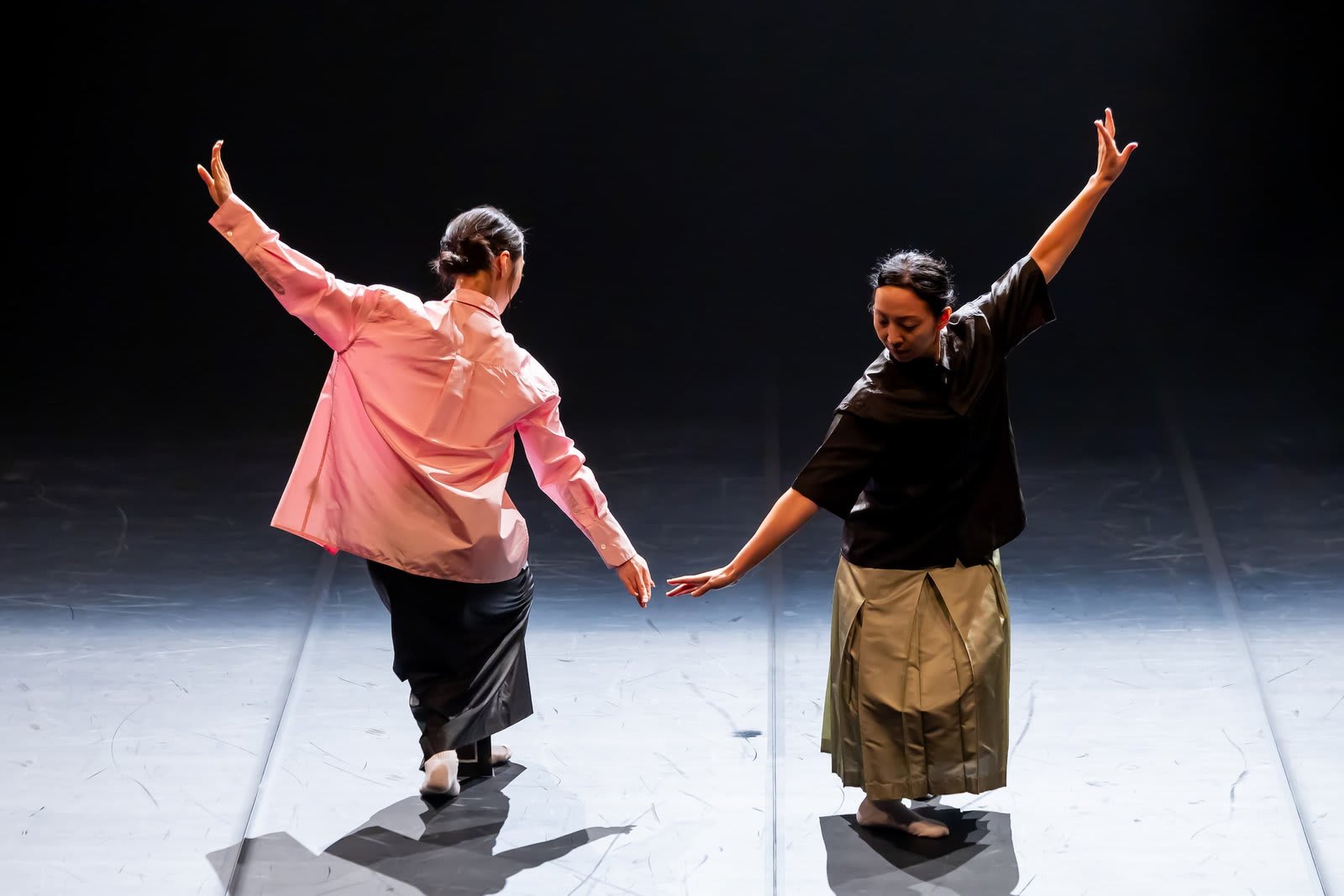
2025년 10월 15일, 서울아트마켓의 PAMS Choice 프로그램을 계기로 나는 안무가 이양희의 Shimmering을 보기 위해 국립극장 하늘극장에 앉았다. 작품은 무대의 조명이 켜지기 훨씬 전부터, 열 명의 무용수의 몸에 오랜 시간 퇴적되어 온 훈련의 시간 속에서 이미 시작된다. 미소 띤 얼굴로 등장하는 이들의 몸에는 오랜 시간 엄격하게 단련된 몸에서만 나올 수 있는 일종의 여유가 배어 있다. 반복과 교정, 통증, 그리고 몸이 수행적 현존을 발산하는 법을 익히기까지 축적해 온 점진적인 노동의 시간. 이양희는 이전 인터뷰에서 이렇게 말한다. “무용수는 몸을 조정하는 시간과 능력이 필요해요. 조정을 하려면 굉장히 고통스럽고 반복적인 훈련이 필요하고 그 시간을 거친 모든 무용수들이 춤을 췄었을때 빛나는 상태가 저한테 쉼머링이에요.”9전통과 현대를 이어가는 퍼포먼스, 이제는 지방시대, 2023년 9월 9일 게시, YouTube 인터뷰 영상. 여기에서 쉼머링 (빛이 나는 상태)은 단순한 은유가 아니라 신체의 진동으로 나타나고 감각된다. 그리고 살아낸 노동의 운동적 잔여가 열 개의 몸으로부터 관객인 우리에게 새어 나오는 바로 그 순간, 그것은 동시에 금방 사라져 간다.
Shimmering은 Gesamtkunstwerk (2019)와 Hail (2020)에 이은 이양희의 Dance’s Pleasure 3부작의 마지막 작품이다.10이양희 스튜디오 웹사이트 참조. https://www.leeyangheestudio.com/. 작품의 움직임 어휘는 한국전통무용과 1990년대 한국 레이브 문화의 미학에서 가져온다. 작품 내내 무용수들은 디스코 조명 아래 경쾌한 테크노 비트에 맞춰 몸을 움직이며, 원형 무대를 다양한 대형으로 드나든다. 때로는 열 명 모두가 한꺼번에 등장하고, 때로는 더 작은 군집으로 흩어져 기본걸음과 같이 고도로 양식화된 한국 전통춤의 기초 동작이나 전통춤 특유의 회전 동작을 수행한다. 무용수들은 인용과 체현 사이의 긴장 속을 오간다. 여기서 전통은 안정적으로 고정된 레퍼토리가 아니라, 무용수의 몸이 시험하고 재구성하고자 하는 하나의 안무로 모습을 드러낸다. 이 긴장은 이미 학습된 것과 다른 방식으로 움직이고자 하는 것 사이에서 발생한다. 하체와 신체의 축은 훈련을 통해 체득한 한국춤의 레퍼토리에 단단히 뿌리내리고 있는 반면, 손 그리고 팔과 상체는 종종 클럽 댄스에서 볼 법한 보다 돌발적이고 즉흥적인 움직임을 향하는 듯하다.
이러한 긴장과 더불어 작품 전체에는 하나의 교육적 흐름이 저류한다. 이는 가령 몇 분간 음악이 사라지고, 녹음된 여성의 목소리가 공간 안으로 들어와 전통춤 교사 특유의 어조로 장단을 구음하는 순간 더욱 분명하게 드러난다. 목소리는 각 움직임의 길이와 질감을 조직하는 즉흥적 리듬 패턴인 장단의 구음을 들려준다. 장단은 단순히 동작의 박자를 세는 단위가 아니라, 학생의 몸을 공간 속으로 이끄는 체화된 기억술로 (mnemonics)도 기능한다. 이 순간 무용수들은 각자의 궤적을 통해 그 지시를 받아들이고 번역한다. 관객은 장단이 엄격하게 움직임을 기보하는 체계라기보다, 형식을 고정하지 않으면서 움직임을 이끄는 하나의 지각적 틀로 작동한다는 사실을 알게 된다. 극장 안에서 이 목소리를 듣는 순간, 평소에는 보이지 않는 전승의 한 차원이 모습을 드러낸다. 이 형식의 계보는 동작에만 존재하는 것이 아니라, 스승이 전하는 리듬과 호흡의 패턴 속에도 살아 있다. 이 순간 몸은 가르침이 남긴 음향적 흔적을 통해 조율된다.
작품은 무용수들이 일정한 간격으로 늘어서 오랜 시간 제자리에서 회전하기 시작할 때 절정에 이른다. 이 이미지는 수피의 회전춤을 연상시키지만, 여기에서 회전은 종교적 또는 헌신적 수사로부터 분리되어 오히려 순수한 테크닉 그 자체를 노출한다. 그 노출은 많은 것을 드러내는 동시에 조금의 관용도 허락하지 않는다. 관객은 무너지지 않은 채 축과 템포, 호흡을 유지하는 일이 얼마나 어려운지를 감지한다. 그리고 한국 전통무용을 공개적으로 질문해 온 이양희의 작업이라는 맥락 안에서 이 장면은 이중의 긴장을 띤다. 그것은 전통에 대한 시험인 동시에 취약성을 공개적으로 드러내는 장면이며, 훈련의 한계가 실시간으로 가시화되는 순간이다.
관객은 발가락, 발목, 무릎, 골반, 흉곽을 가로질러 끊임없이 이루어지는 미세한 조정들로 채워진 시간을 목격한다. 이 미세한 조정들은 몸의 조율 과정을 마치 ‘교정의 안무’처럼 읽을 수 있게 만든다. 이 시퀀스는 바라보는 것조차 버거울 만큼 잔혹하게 느껴진다. 누가 타이밍을 몸에 깊이 새겼는지, 누가 축을 유지하는지, 그리고 누구의 몸에 가장 긴 교정의 역사가 축적되어 있는지가 순식간에 드러나기 때문이다. 열 명의 무용수 가운데 이양희의 몸은—눈에 띄게 더 나이가 들었지만 더 안정적이고, 테크노 비트와 리듬적으로 더욱 정확하게 맞물리는 몸은—가장 깊이 조율된 몸으로 떠오른다. 젊은 무용수들의 형태와 축이 흐트러지고 음악과의 싱크가 어긋나기 시작한 뒤에도 그의 몸은 오랫동안 일관성을 유지한다. 열 명이 계속해서 회전하는 동안 우리는 서로 다른 열 개의 훈련의 시간들이 나란히 회전하는 것을 보게 된다. 각각의 몸은 저마다 조금씩 다른 밀도로 살아낸 전통의 시간을 품고 있으며, 훈련과 부상, 회복의 아카이브가 몸에서 공간으로 새어 나온다.
각각의 회전에는 퇴적된 노동과 미세한 변형, 그리고 피로의 기억이 담겨 있다. 이를 자동화(automation)와 신체 노동, 보존(preservation)의 정치학을 둘러싼 동시대 예술의 논의 안에 위치시켜 본다면, ‘조율의 움직임’은 디지털화로 인해 위협받는 체화된 지식의 형태로서 공예와 숙련된 기술의 위상을 다시 질문하는 수많은 예술가들의 작업에 하나의 응답을 제시한다. 머신러닝 (machine learning) 시스템의 폐는 지칠 수 없다. 그것은 회복된 부상이 남긴 비대칭을 기억하지도, 그것을 짊어지기로 선택하지도 않는다. 오랜 연습이 남긴 미세한 떨림 역시 갖지 않는다. 때로는 고통스럽고 때로는 지극히 일상적인 조율의 움직임은 스스로를 반복해서 위험에 내맡겨 왔으며 빠른 최적화를 거부해 온 하나의 몸을 만들어낸다. 그리고 가속할 수 없는 수많은 시간이 흐른 뒤에야 비로소 라이브 관객 앞에서 이 짧고 반짝이는 순간이 모습을 드러낸다. 그러나 나타난 바로 그 순간, 다시 사라진다. 그것은 과잉이다. 그리고 그 무엇도 효율적이지 않다.
1960~70년대 루신다 차일즈(Lucinda Childs)11Sally Banes, Terpsichore in Sneakers: Post-Modern Dance (1980; reprint, Wesleyan University Press, 2011); Ramsey Burt, Judson Dance Theater: Performative Traces (Routledge, 2006) 참조. 와 이본 레이너(Yvonne Rainer)12Yvonne Rainer, “A Quasi-Survey of Some Minimalist Tendencies in the Quantitatively Minimal Dance Activity Midst the Plethora, or an Analysis of Trio A,” in Minimal Art: A Critical Anthology, ed. Gregory Battcock (1968; reprint, Dutton, 1995), 263–73 참조. 같은 포스트모던 안무가들이 구성의 논리와 테크닉의 가치 자체를 재조직함으로써 춤의 구조적 전환을 만들어냈다면, Shimmering의 실험은 그러한 구조적 전환보다는 다른 층위에서 이루어진다. 차일즈와 라이너의 개입은 전승된 움직임 어휘를 새로운 분위기 속에 재배치하는 데 그치지 않았다. 축소, 과제 기반의 움직임, 반복, 그리고 기교를 형식의 최우선 척도로 삼기를 거부함으로써 애초에 무엇이 춤의 구조로 간주될 수 있는지를 새롭게 정의했다. 이와 대조적으로 이양희의 작업은 전통의 기술적 문법을 근본적으로 온전한 상태로 남겨둔다. 작품의 실험은 구조의 재정의보다는 감각적 프레이밍과 양식적 병치의 차원에서 이루어진다. 그 결과 만들어지는 것은 전통춤의 문법을 다시 쓰는 일이 아니라, 그 문법이 몸에 요구하는 것과 그로 인해 치러야 하는 대가를 더욱 선명하게 가시화하는 일이다.
Shimmering은 한국전통음악을 레이브를 연상시키는 테크노로 대체하고, 상체에 클럽 문화의 진동과 떨림을 주입하며, 디스코를 연상시키는 조명을 도입하고, 현대성을 암시하는 오버사이즈 티셔츠를 무용수들에게 입힘으로써 한국 전통춤의 프레임을 느슨하게 만드는 듯 보인다. 이러한 요소들은 전통을 동시대의 감각적 체제 안에서 재구성하려는 의지를 보여준다. 그러나 그 기술적 핵심은 여전히 엄격하게 전통적이다. 발놀림과 템포, 축, 하체의 규율은 거의 일탈 없이 기존의 구조를 따른다. 유니슨이 지배적이며, 안무는 개개인의 차이와 무관하게 균일한 수행을 요구한다. 스승과 제자의 차이가 가시화되는 이유도 여기에 있다. 여기서 정확성은 하나의 스타일이 아니라 인프라다. 바로 그 정확성이 전통으로 하여금 비로소 모습을 드러낼 수 있게 한다.
이 작품이 드러내는 것은 조율이 고정된 상태가 아니라 지속적인 움직임이라는 사실이다. 그것은 과거와 미래 사이에 머물기 위해 몸이 무엇을 내어주어야 하는지를 끊임없이 협상하는 과정이다. 이 안무는 체현보다 인용을, 위험을 감수하는 일보다 참조를 선호하는 체계 속에서 체화된 지식을 지속한다는 것이 얼마나 어려운지를 직면하게 한다. 작품은 감탄을 불러일으키지만, 동시에 우리에게 더욱 불편하고 쉽게 해소되지 않는 하나의 질문을 남긴다. 점점 더 비신체적인 보존의 형식에 의해 구조화되어 가는 세계에서, 전통을 단지 암시하거나 가리키는 것이 아니라 자신의 몸으로 살아내는 일이 몸에 어떤 대가를 요구하는지 다시 생각하게 한다.